


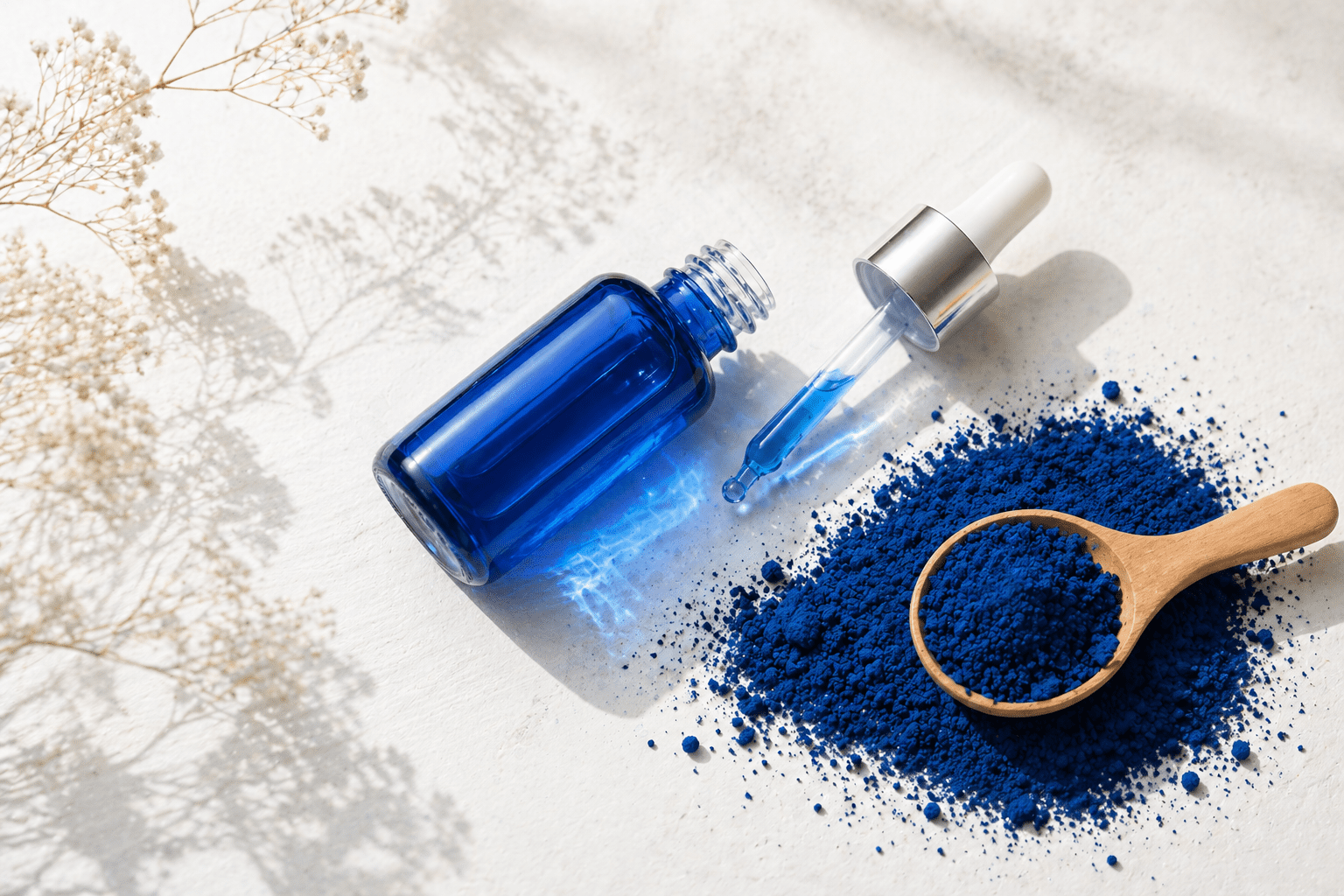
Phycocyanin is one of the most distinctive bioactive compounds derived from microalgae, primarily extracted from Spirulina and Aphanizomenon flos-aquae. While it is often recognized for its intense blue color, its true value extends far beyond aesthetics. It represents a rare category of ingredients that combine functional performance with visual impact, making it a cornerstone in modern nutraceutical, cosmetic, and food innovation.
Unlike traditional pigments that serve a purely decorative role, phycocyanin contributes directly to biological activity. This dual functionality allows formulators to simplify compositions while increasing product value, aligning with the growing demand for clean-label and multifunctional ingredients.
Origin and Biochemical Nature
Phycocyanin belongs to the phycobiliprotein family, a group of water-soluble proteins responsible for capturing light energy during photosynthesis in microalgae. Its molecular structure enables efficient light absorption, which explains its vibrant blue color. However, this same structure also contributes to its antioxidant capacity.
According to your brochure, phycocyanin extracted from Spirulina and AFA exhibits strong antioxidant, anti-inflammatory, immunomodulatory, and detoxifying properties, supported by multiple scientific studies :contentReference[oaicite:1]{index=1}. This positions it as a bioactive compound rather than a simple pigment.
Mechanism of Action: Multifunctional Biological Activity
Phycocyanin operates through several interconnected biological pathways, which explains its wide range of applications.
Oxidative Stress Reduction
Phycocyanin neutralizes reactive oxygen species (ROS), including hydroxyl radicals and peroxides. By reducing oxidative stress, it helps preserve cellular structures such as lipids, proteins, and DNA. This protective effect is essential for maintaining long-term cellular function.
Modulation of Inflammatory Pathways
One of its key mechanisms involves the inhibition of pro-inflammatory enzymes such as COX-2 and iNOS. By regulating these pathways, phycocyanin reduces the production of inflammatory mediators, contributing to improved tissue balance and recovery.
Liver Protection and Detox Support
Phycocyanin acts as a natural chelating agent, assisting in the elimination of heavy metals and toxins. In addition, it protects liver cells from oxidative damage, supporting overall detoxification processes.
Neuroprotective Activity
Its antioxidant properties extend to neural tissues, where it helps protect neurons from oxidative damage. This contributes to improved mitochondrial function and supports cognitive resilience.
Lipid Metabolism Regulation
Phycocyanin has also been shown to influence lipid metabolism by reducing LDL oxidation and supporting cardiovascular health, further expanding its functional scope.
Key Benefits in Real Applications
The practical value of phycocyanin lies in its ability to deliver distinct benefits depending on the formulation context, without relying on repetitive or overlapping claims.
In nutraceutical applications, it supports antioxidant defense and immune modulation, making it suitable for daily wellness products. Its ability to reduce oxidative stress contributes to long-term health maintenance rather than short-term intervention.
In functional food and beverage systems, phycocyanin provides a natural blue color while enhancing the nutritional profile. This dual functionality reduces the need for additional synthetic additives, aligning with clean-label trends.
In cosmetic formulations, phycocyanin contributes to skin protection by reducing environmental stress factors. Its antioxidant and anti-inflammatory properties help maintain skin balance, improve resilience, and support overall skin vitality.
In detox-focused products, it acts as a supportive ingredient by enhancing the body’s natural defense mechanisms. Instead of acting as a primary cleansing agent, it stabilizes internal conditions, allowing other detox ingredients to perform more effectively.
Finally, phycocyanin plays a strategic role in multi-ingredient systems. By reducing oxidative stress, it creates a more stable environment for other actives, improving overall formulation efficiency.
Phycocyanin as a Functional Pigment
One of the most unique aspects of phycocyanin is its role as a functional pigment. Unlike synthetic colorants that provide only visual appeal, phycocyanin adds biological value to the formulation.
This makes it particularly attractive for brands seeking to differentiate their products through both appearance and performance. It allows for the development of visually striking formulations without compromising on functionality.
In addition, its natural origin aligns with consumer demand for sustainable and clean-label ingredients, further enhancing its market appeal.
Comparison with Conventional Colorants
| Feature | Phycocyanin | Synthetic Colorants |
|---|---|---|
| Origin | Microalgae (natural) | Chemical synthesis |
| Functionality | Color + bioactivity | Color only |
| Health Contribution | Antioxidant, anti-inflammatory | None |
| Consumer Perception | Clean label, natural | Artificial |
This comparison highlights the strategic advantage of phycocyanin in modern formulations, where functionality and transparency are increasingly important.
Formulation Considerations
Phycocyanin is water-soluble and integrates well into aqueous systems, making it suitable for beverages, serums, and liquid formulations. However, it is sensitive to external factors such as heat, light, and pH variations.
To maintain stability, formulation strategies often include controlled processing conditions or protective systems such as encapsulation. These approaches help preserve both its color intensity and biological activity.
In cosmetic systems, phycocyanin can be combined with delivery technologies to improve stability and enhance penetration, increasing its overall effectiveness.
Market Positioning and Innovation Potential
Phycocyanin occupies a unique position at the intersection of aesthetics and functionality. Its ability to serve as both a colorant and a bioactive ingredient allows brands to streamline formulations while increasing product value.
As the industry moves toward multifunctional ingredients, phycocyanin is becoming a key component in next-generation products. Its versatility across nutraceutical, cosmetic, and food applications provides significant opportunities for innovation.
Furthermore, its compatibility with other microalgae-based ingredients enables the creation of cohesive product lines, reinforcing brand identity and scientific credibility.
Conclusion
Phycocyanin is far more than a natural blue pigment. It represents a new class of multifunctional ingredients that combine visual impact with measurable biological benefits. Through its antioxidant, anti-inflammatory, and detox-supporting properties, it contributes to both product performance and consumer appeal.
For formulators and developers, phycocyanin offers a strategic advantage: the ability to deliver both functionality and differentiation within a single ingredient. This positions it as a key driver in the evolution of clean-label, high-performance formulations.
Scientific References


