
Modern skincare innovation is increasingly focused on how active ingredients interact with the skin. While peptides, antioxidants, and other functional ingredients offer considerable formulation potential, their performance can depend on how effectively they reach their intended site of action.
Spicule-based technologies provide a physical approach to enhancing ingredient delivery. Traditionally derived from marine sponges, these microscopic structures interact mechanically with the skin surface to support the penetration of cosmetic actives.
A new generation of vegan spicules introduces mineral-engineered micro-rods designed to provide more consistent particle geometry, controlled mechanical stimulation, and new possibilities for advanced topical delivery systems.
For cosmetic formulators, this technology offers an alternative to biologically sourced spicules while opening opportunities for high-performance serums, targeted treatments, and multifunctional skincare formulations.
Why Cosmetic Scientists Are Rethinking Sponge Spicules
Traditional cosmetic spicules are commonly extracted from marine sponges. Their rigid microscopic structures can mechanically interact with the stratum corneum, influencing the movement of ingredients through the skin’s outer barrier.
However, their biological origin presents several formulation considerations.
Natural sponge-derived particles may exhibit variations in geometry, dimensions, and surface characteristics. Their marine animal origin also makes them unsuitable for formulations seeking vegan certification.
Mechanical stimulation can additionally produce tingling, redness, or discomfort, depending on particle characteristics, use concentration, formulation composition, and application conditions.
These considerations have encouraged the development of engineered spicule alternatives with more defined physical specifications.
Rather than relying on naturally occurring sponge skeletons, mineral-engineered systems offer a different approach to particle design and manufacturing consistency.
Mineral-Engineered Micro-Rods: Structure and Function
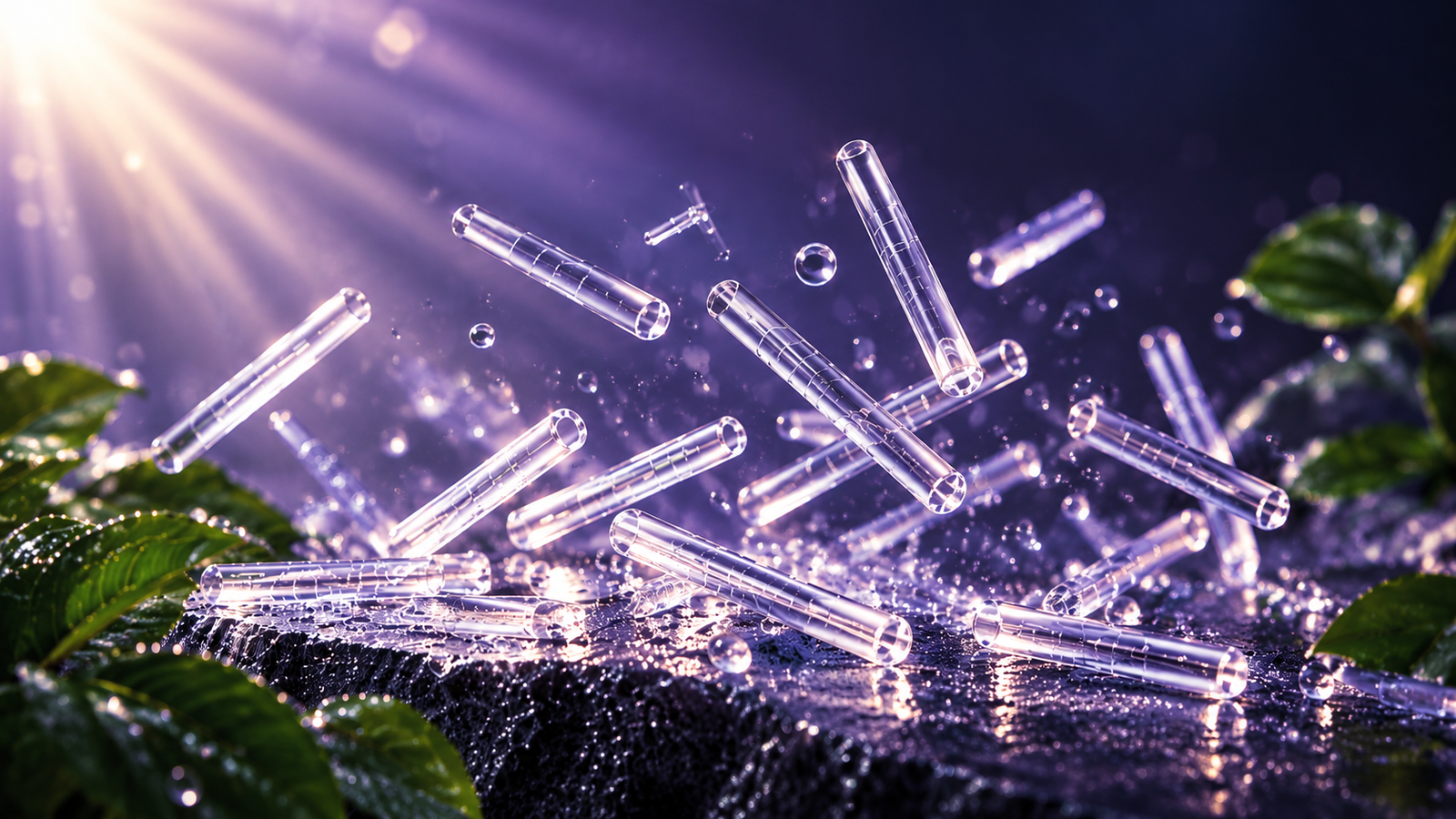
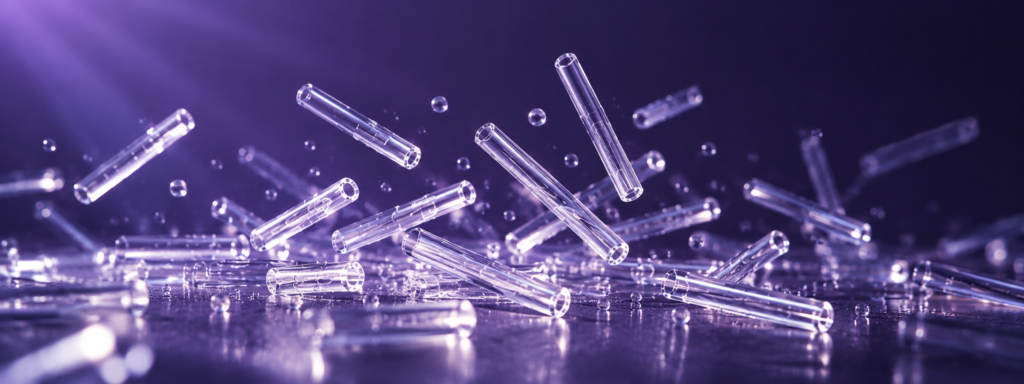
Vegan Spicule technology uses synthetic mineral microstructures based on Calcium Aluminum Borosilicate.
Unlike conventional sponge-derived spicules, these engineered particles are manufactured with controlled dimensions and elongated micro-rod geometry.
The technology is characterized by:
- Mineral-based, non-animal sourcing
- Defined particle length distributions
- Approximately 11 μm particle width
- Micro-rod structures designed for mechanical skin interaction
- Multiple grades suited to different formulation requirements
The mineral composition allows cosmetic scientists to explore spicule-based delivery without relying on animal-derived materials.
Particle dimensions remain particularly important because length, width, concentration, and surface characteristics can influence the intensity of mechanical stimulation and the sensory response of a finished formulation.
By offering defined particle specifications, vegan spicules provide formulators with measurable parameters for product development.
Vegan Spicules vs. Traditional Sponge Spicules
Although both technologies rely on mechanical interaction with the skin, their sourcing and structural characteristics differ.
| Property | Sponge Spicules | Vegan Spicules |
|---|---|---|
| Origin | Marine sponges | Synthetic mineral |
| Composition | Primarily silica | Calcium Aluminum Borosilicate |
| Structure | Naturally occurring needle-like structures | Engineered micro-rods |
| Particle geometry | Biologically derived | Defined manufacturing specifications |
| Vegan compatibility | Not suitable | Suitable, subject to certification |
| Skin interaction | Mechanical stimulation | Mechanical stimulation |
| Formulation approach | Biologically sourced particles | Engineered particle technology |
The principal distinction is not simply the absence of animal-derived materials. Engineered micro-rods also provide an opportunity to select particle dimensions according to formulation objectives.
Nevertheless, irritation, penetration depth, and overall performance should be evaluated in the finished formulation rather than assumed from particle geometry alone.
Enhancing Active Ingredient Delivery Through Mechanical Stimulation
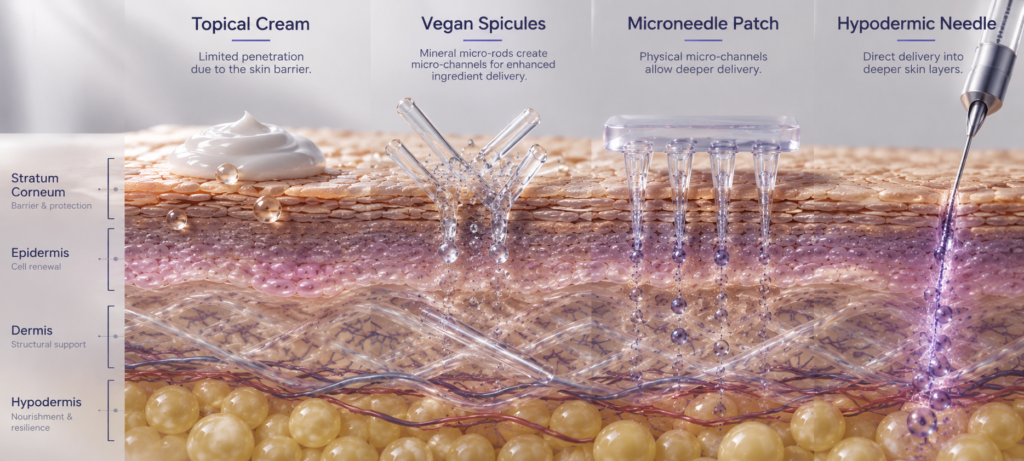
The stratum corneum represents the skin’s primary barrier to external substances. Its organized lipid structure helps regulate water loss while restricting the movement of many topically applied compounds.
For cosmetic scientists, this protective function presents a challenge when developing formulations intended to deliver functional ingredients into superficial skin layers.
Spicule technologies use microscopic structures to produce localized mechanical interactions with the skin surface.
These interactions may temporarily alter superficial barrier permeability, potentially supporting the movement and distribution of ingredients within the skin.
Unlike conventional chemical penetration enhancers, which influence barrier properties through chemical interactions, spicules introduce a physical delivery mechanism.
This makes them an interesting formulation platform for investigating the delivery of selected cosmetic actives, including peptides, antioxidants, and other ingredients where improved superficial skin availability is desirable.
The degree of enhancement will depend on the active ingredient, vehicle, particle concentration, and application conditions.
What In-Vivo Skin Absorption Testing Reveals
Beyond the structural characteristics of the particles, experimental skin absorption data provide important insight into the potential of vegan spicule technology.
In a comparative in-vivo evaluation summarized in the supplier’s technical documentation, a conventional serum was assessed alongside a serum containing Vegan Spicules.
Raman spectroscopy was used to evaluate skin absorption characteristics, including the measured amount, rate, and depth.
Reported Skin Absorption Results
| Measurement | Conventional Serum | Vegan Spicule Serum |
|---|---|---|
| Absorption amount before (A.U.) | 304,212 | 302,442 |
| Absorption amount after (A.U.) | 434,279 | 593,524 |
| Reported absorption amount increase | 42.8% | 96.2% |
| Absorption depth before | 33.4 μm | 31.0 μm |
| Absorption depth after | 60.4 μm | 70.0 μm |
The Vegan Spicule formulation demonstrated a larger increase in measured absorption amount than the conventional serum under the reported test conditions.
The reported absorption depth also increased from 31.0 μm to 70.0 μm in the Vegan Spicule group, compared with an increase from 33.4 μm to 60.4 μm in the control group.
These findings suggest that the addition of engineered micro-rods may influence the skin distribution of formulation components.
However, the percentages represent changes within each treatment group and should not be interpreted as direct percentage improvements over the control.
The study summary does not provide complete information on participant numbers, statistical analysis, or all experimental conditions. Accordingly, the findings should be interpreted as preliminary supporting evidence rather than universal performance claims.
Hollow Vegan Spicules: A New Approach to Active Loading
One of the most interesting developments in engineered spicule technology is the exploration of hollow micro-rod structures.
Conventional spicules primarily function through their physical interaction with the skin. Hollow structures introduce another potential function: providing an internal space for carrying cosmetic ingredients.
In principle, these microstructures can be designed to combine two complementary mechanisms:
Mechanical interaction: The elongated micro-rod interacts with superficial skin structures, potentially modifying local ingredient transport.
Active loading: The hollow internal structure provides a potential reservoir for carrying selected cosmetic compounds.
This creates opportunities to investigate spicule platforms that combine physical stimulation with ingredient loading and release.
Such technologies could be relevant to advanced peptide formulations, antioxidant delivery, and other targeted cosmetic applications.
Release kinetics, loading efficiency, ingredient compatibility, and actual skin delivery performance must be established experimentally for each system.
Rather than viewing spicules solely as exfoliating or stimulating particles, hollow micro-rod engineering introduces the possibility of a more sophisticated delivery platform.
Exploring Spicule Synergy in an Artificial Skin Model
Additional technical evaluation has examined the distribution of a fluorescent marker using sponge-derived spicules, vegan spicules, and a combination of both.
The investigation used an artificial skin model and fluorescence imaging to compare marker distribution following treatment.
Reported Fluorescence Expression Area
| Treatment | Fluorescence area |
|---|---|
| Control | No reported signal |
| Sponge spicules | 525 pixels |
| Vegan spicules | 889 pixels |
| Sponge + Vegan spicules | 3,719 pixels |
Under the reported experimental conditions, the Vegan Spicule treatment produced approximately 1.7 times the fluorescence-expression area of the sponge-spicule treatment.
Combining the two spicule types produced a substantially larger fluorescence-expression area than either treatment alone.
These findings suggest that combining microstructures with different physical characteristics may offer an interesting strategy for optimizing marker distribution.
Importantly, fluorescence-expression area is an experimental distribution measurement. It does not independently establish improved clinical skin benefits, ingredient bioavailability, or treatment efficacy.
Nevertheless, the findings provide an additional direction for research into hybrid spicule-based delivery systems.
Selecting the Right Vegan Spicule Grade
Particle size is an important consideration in the development of spicule-containing skincare formulations.
The Vegan Spicule series includes three standard mineral micro-rod grades, each characterized by a different upper particle-length distribution.
| Grade | Length (D90) | Approximate Width | Recommended Use Level |
|---|---|---|---|
| Vegan Spicule 75 | Less than 75 μm | 11 μm | 0.5–10% |
| Vegan Spicule 150 | Less than 150 μm | 11 μm | 0.5–5% |
| Vegan Spicule 200 | Less than 200 μm | 11 μm | 0.5–3% |
All three grades are based on Calcium Aluminum Borosilicate.
The reported values provide an initial framework for grade selection, but particle size alone does not determine performance.
Formulators should evaluate sensory characteristics, dispersion, stability, application frequency, and tolerability at the intended use concentration.
Certification should also be reviewed for the specific grade. The supplied technical documentation identifies Korean vegan certification for Vegan Spicule 150, rather than for every grade in the series.
Formulation Considerations for Cosmetic Chemists
Successful incorporation of spicules requires attention to more than particle size or nominal use concentration.
Particle dispersion and uniformity
Consistent distribution throughout the formulation is important for achieving reproducible application and sensory characteristics. Formulation viscosity, processing conditions, and particle settling should be assessed during development.
Sensory profile and tolerability
Mechanical stimulation may produce tingling or other sensory effects. These should be evaluated alongside use concentration, particle grade, application method, and intended consumer population.
Compatibility with cosmetic actives
Peptides, antioxidants, brightening ingredients, and other functional compounds may offer interesting development opportunities. However, enhanced delivery should be verified for the particular ingredient and formulation.
Packaging and physical stability
Particle suspension, product uniformity, and dispensing behavior should be considered when selecting packaging formats and establishing stability protocols.
Finished-product safety
Because spicule-containing formulations can mechanically interact with the skin barrier, irritation, repeated-use tolerability, and appropriate directions for use should be established through suitable testing.
These considerations help translate promising ingredient technology into reproducible finished-product performance.
Applications in Advanced Skincare
Engineered vegan spicules can be explored across several formulation categories.
Skin renewal serums: Lightweight treatment systems where controlled particle dispersion and a defined sensory profile are important.
Targeted cosmetic treatments: Formulations intended to combine mechanical stimulation with selected functional ingredients.
Brightening formulations: Delivery-oriented systems incorporating cosmetic ingredients such as niacinamide or other suitable brightening actives, subject to compatibility and efficacy testing.
Age-management skincare: Formulations combining physical delivery approaches with peptides, antioxidants, or other ingredients associated with the appearance of skin firmness and texture.
Advanced delivery platforms: Experimental formulations investigating hollow microstructures, active loading, or combinations of complementary delivery technologies.
The appropriate application will depend on the selected spicule grade, formulation characteristics, intended use, and finished-product safety evaluation.
The Future of Vegan Spicule Technology
Spicule technology is evolving from biologically derived microscopic particles toward more deliberately engineered delivery structures.
Defined particle dimensions, mineral-based sourcing, and emerging hollow micro-rod designs provide new opportunities to explore how physical microstructures can support topical formulation performance.
Future development may investigate combinations with encapsulation systems, including liposomal technologies, peptide carriers, and other delivery platforms.
The most meaningful progress will come from connecting particle engineering with rigorous evaluation of ingredient delivery, skin tolerability, and finished-product performance.
For cosmetic scientists, vegan spicules represent an expanding area of ingredient technology where material structure and formulation science intersect.
Explore Vegan Spicule Technology
Discover our range of mineral-engineered Vegan Spicules, available in different particle sizes and hollow micro-rod structures for advanced cosmetic formulations. Explore product specifications, technical documentation, and request samples for your next skincare development.