

Exploring the Science Behind Firmer, Brighter and More Resilient Skin
Great skincare rarely comes down to one biological pathway. Skin firmness, pigmentation, and barrier function all depend on different cellular processes. As cosmetic science moves toward multifunctional ingredients, the challenge is finding actives that can address several concerns without making formulations unnecessarily complex.
STELLAR brings an interesting perspective to this approach. Derived from Stellera chamaejasme, this botanical active has been investigated for its effects on skin renewal, collagen-associated pathways, pigmentation, and barrier function. Its research combines in vitro studies with clinical evaluations, connecting biological activity with measurable changes in skin appearance.
What makes STELLAR particularly interesting is the range of mechanisms behind its performance. Rather than focusing on a single cosmetic benefit, it offers several research directions within one botanical ingredient.
From Traditional Botanical to Modern Skin Science
Stellera chamaejasme has a long history in traditional Mongolian botanical practices. Today, scientific research is exploring its potential through a different lens. Researchers have investigated its naturally occurring compounds and their interactions with cellular processes involved in skin maintenance and renewal.
STELLAR builds on this foundation through studies covering several areas of skin biology. These include keratinocyte movement, collagen-associated activity, inflammatory signaling, and melanin production. Each pathway plays a different role in how skin looks and responds to environmental stress.
For formulators, this creates an opportunity to explore a botanical active with multiple functions. The goal is not simply to combine more benefits in one ingredient. It is to understand how different mechanisms may contribute to visible cosmetic performance.
In Vivo Efficacy: What Changed After Four Weeks?
Laboratory results are important, but cosmetic chemists also want to see what happens in a finished formula. STELLAR was evaluated in a four-week clinical study at the OATC Skin Clinical Trial Center. The study involved 20 Korean women aged 35–60. Participants applied a facial serum containing 5% STELLAR twice daily.
After 28 days, instrumental testing showed a 10.89% improvement in skin firmness. Researchers also recorded improvements in several facial wrinkle measurements. These included an 18.98% reduction in laugh-line sunken volume and a 17.10% reduction in marionette-line sunken volume.
The results extended beyond firmness and wrinkles. Skin imaging also revealed changes in brightness and pigmentation-related measurements. Researchers recorded improvements in complexion luminosity and the study’s abnormal melanin-content indicator.
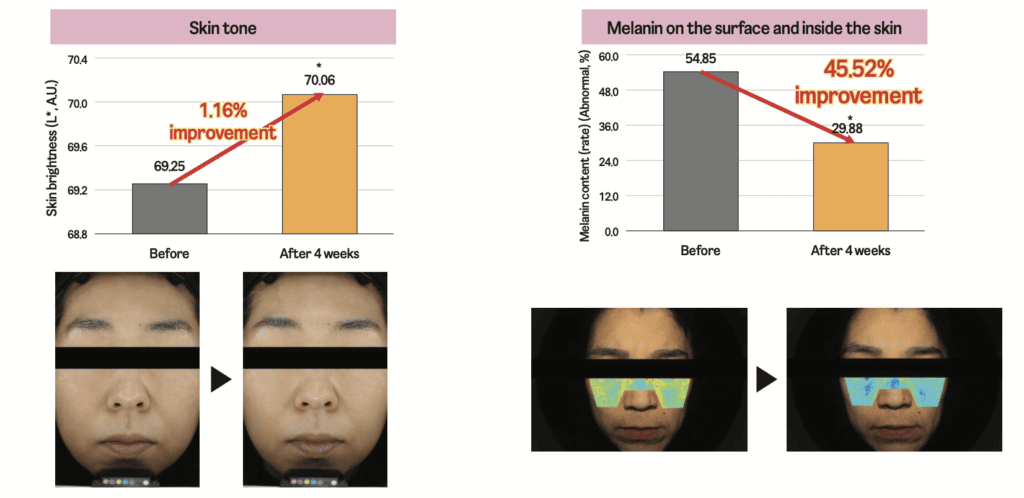
Four-week clinical evaluation showing changes in skin brightness and melanin-related measurements, with representative before-and-after images.
These observations highlight the broader potential of the tested formulation. Instead of focusing on a single aging concern, the clinical evaluation examined several aspects of skin appearance. This makes STELLAR particularly interesting for well-aging and brightening concepts where multiple benefits are part of the formulation strategy.
Looking Beneath the Surface: The Biology Behind STELLAR
Visible results tell one part of the story. Understanding how an ingredient interacts with skin cells adds another important dimension. STELLAR has been investigated through several in vitro models, offering insight into its effects on cellular behavior.
One area of interest is skin renewal. In human keratinocyte studies, STELLAR promoted cell migration compared with the experimental control. The research also included Centella asiatica as a botanical comparator. Cell migration is relevant because keratinocytes help maintain the epidermis and support normal skin renewal.
Collagen-related activity provides another important connection. Human fibroblast studies examined markers associated with type I and type III collagen. Additional experiments investigated MMP-1, an enzyme involved in collagen breakdown, and type I procollagen production.
The results showed changes in collagen-associated expression, reduced UVB-induced MMP-1, and increased type I procollagen under the tested conditions. These findings help explain why STELLAR is worth exploring in formulations targeting firmness and visible signs of aging.
The research also extends to pigmentation. In cellular melanogenesis studies, STELLAR reduced melanin formation and release across the tested concentrations. This provides a biological connection to the brightness-related improvements observed in the clinical evaluation.
More Than Anti-Aging: Skin Barrier and Comfort
Skin performance is about more than wrinkles and pigmentation. A healthy barrier helps maintain moisture and supports the skin’s response to everyday stress. This makes barrier-related activity increasingly relevant to modern skincare development.
STELLAR demonstrated interesting results in keratinocyte models examining filaggrin, a protein associated with barrier integrity and natural moisturizing factor formation. The experiments showed increased filaggrin expression alongside reduced TARC expression, a marker linked to inflammatory signaling.
Additional cellular studies explored inflammatory mediators and sebum-associated pathways. Together, these findings expand the ingredient’s research profile beyond conventional firming and brightening.
While in vitro responses do not automatically predict clinical performance, they help identify potential mechanisms. They also provide useful directions for further formulation research.
A Multifunctional Approach to Cosmetic Formulation
The opportunity with STELLAR lies in connecting these different areas of skin biology. Firmness, complexion uniformity, epidermal renewal, and barrier function are closely related to the overall appearance of healthy-looking skin.
For cosmetic chemists, STELLAR presents opportunities across well-aging serums, brightening treatments, revitalizing ampoules, and barrier-focused skincare. Its combination of cellular research and clinical observations provides a starting point for developing formulas with multiple cosmetic objectives.
The clinical study used a serum containing 5% STELLAR. As with any active ingredient, formulators should evaluate compatibility, stability, and performance within their own finished products.
Explore the Science Behind STELLAR
STELLAR brings together botanical research, complementary cellular mechanisms, and measurable clinical observations. Its research profile extends from collagen-associated pathways and epidermal renewal to pigmentation and skin barrier-related activity.
For R&D teams exploring multifunctional botanical ingredients, the full research offers a closer look at the mechanisms and efficacy results behind STELLAR.