

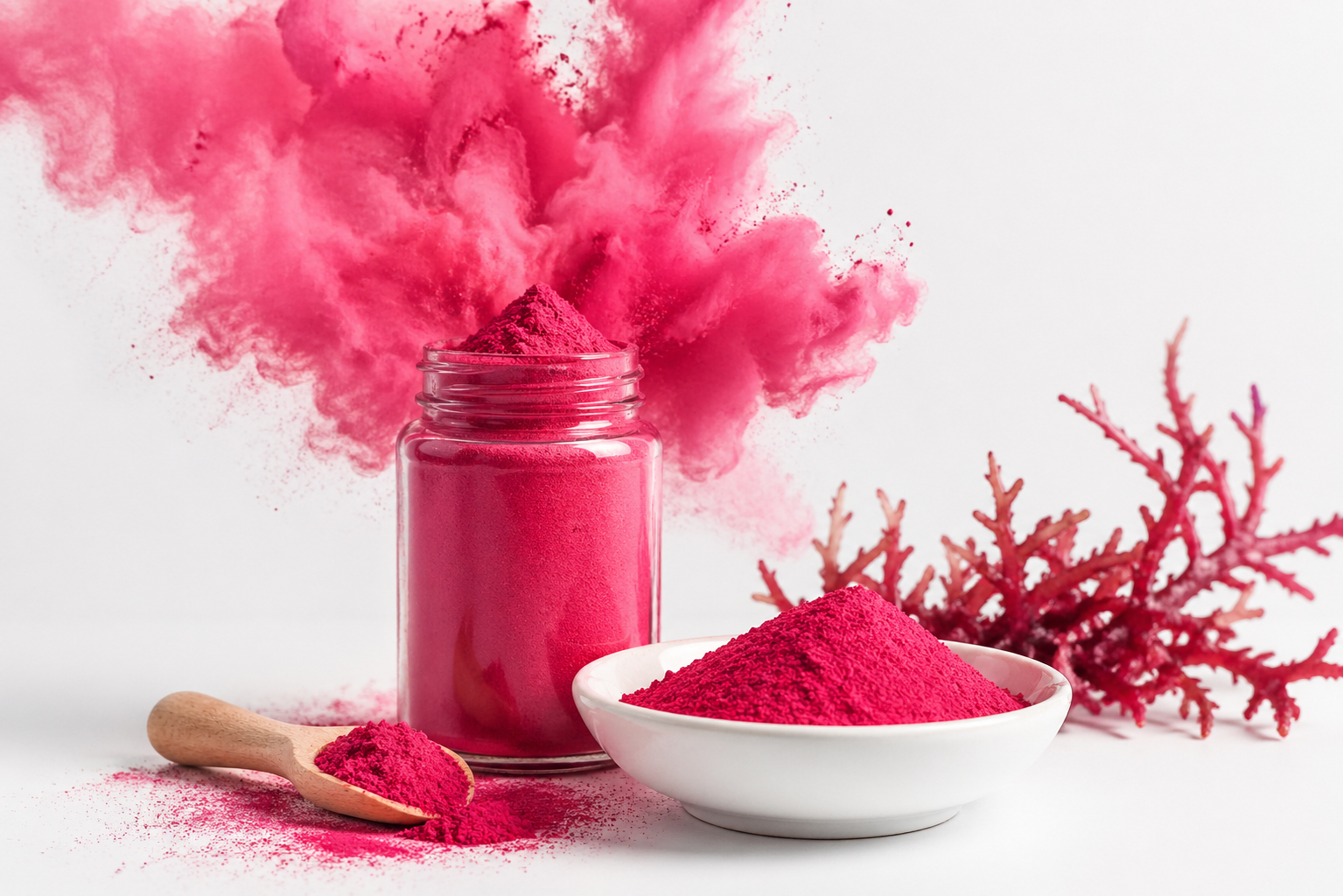
Phycoerythrin is a biotechnology-derived, water-soluble red pigment obtained from red microalgae, particularly Porphyridium species. Unlike conventional colorants that primarily contribute visual appearance, phycoerythrin belongs to a class of naturally occurring protein-pigment complexes known as phycobiliproteins. Its molecular structure combines distinctive optical properties with antioxidant activity demonstrated in experimental research, creating opportunities for multifunctional cosmetic, personal care, and selected nutritional formulations.
The ingredient offers formulators an approach to developing naturally colored aqueous systems while exploring biological functionality beyond pigmentation. Its characteristic pink-to-red color originates from specialized light-absorbing structures, while its protein-based composition differentiates it from synthetic dyes and lipid-soluble pigments such as beta-carotene. This combination is particularly relevant to cosmetic chemists developing visually distinctive serums, gels, emulsions, and advanced skincare concepts.
Microalgal Origin and Biotechnology
Phycoerythrin Production from Porphyridium
Porphyridium is a genus of unicellular red microalgae recognized for producing valuable pigments, proteins, and extracellular polysaccharides. During cultivation, these microorganisms synthesize phycoerythrin as part of their photosynthetic light-harvesting machinery. The pigment contributes to the efficient capture of wavelengths that chlorophyll does not absorb as effectively, allowing the organism to utilize available light energy.
Controlled cultivation offers opportunities to influence biomass production and pigment accumulation through changes in light conditions, nutrient supply, temperature, and other environmental parameters. Following cultivation, phycoerythrin can be recovered through cell disruption, aqueous extraction, and purification processes designed to preserve its molecular integrity.
Why Protein Structure Matters
Phycoerythrin differs fundamentally from many conventional cosmetic pigments because it is a chromoprotein rather than a simple colored molecule. Its protein structure contains light-absorbing chromophores known as phycoerythrobilins, which are responsible for its distinctive optical characteristics.
These chromophores are attached to protein subunits that help maintain their molecular environment and influence light absorption. The resulting complex exhibits strong visible coloration and fluorescence, properties that have also made purified phycoerythrin valuable in biotechnology and analytical applications.
Maintaining this protein structure is important for preserving color intensity and functional activity. Changes in temperature, pH, or chemical environment can affect protein conformation and alter the optical properties of the ingredient.
Natural Red Color and Optical Performance
Red and Pink Color Development
Phycoerythrin absorbs light primarily in the green-to-yellow region of the visible spectrum. This characteristic produces its recognizable red-to-pink appearance and gives the pigment distinctive optical properties.
For cosmetic formulators, the ability to introduce color through a water-soluble biological pigment creates opportunities for developing visually differentiated products. Depending on pigment concentration, purity, formulation composition, and optical conditions, phycoerythrin can contribute pink, rose, or red coloration.
The final appearance depends on more than pigment dosage. Product transparency, background color, packaging, pH, and interactions with other formulation components can all influence the perceived shade.
Color and Functional Ingredient Positioning
Traditional cosmetic colorants generally serve an aesthetic purpose, while functional cosmetic ingredients are selected for their biological or physicochemical properties. Phycoerythrin offers the potential to combine these objectives within a single ingredient.
Its established pigment function can provide visible product differentiation, while published experimental studies support interest in its antioxidant properties. However, antioxidant activity observed in isolated phycoerythrin or experimental models does not by itself establish clinical efficacy in a finished skincare product.
This dual positioning offers an opportunity to develop formulations that use color as part of a broader ingredient-science concept, provided all biological claims receive appropriate substantiation.
Mechanism of Action and Antioxidant Activity
Interaction with Reactive Oxygen Species
Phycoerythrin has demonstrated antioxidant activity in laboratory investigations. Research associates this behavior with its chromophore-containing protein structure, which can participate in reactions involving reactive species.
Reactive oxygen species are generated through normal cellular metabolism and can increase under environmental stress. Excessive oxidative activity may contribute to changes in cellular lipids, proteins, and other biological components.
Phycoerythrin’s antioxidant properties provide a scientific basis for investigating its role in cosmetic formulations designed around oxidative stress management. The effectiveness of this activity depends on pigment integrity, concentration, and the experimental environment.
The Contribution of Phycoerythrobilin
Phycoerythrobilin is a tetrapyrrole chromophore responsible for much of phycoerythrin’s light absorption. Its conjugated molecular structure contributes to the optical behavior of the pigment and is considered relevant to its antioxidant activity.
Research into phycobiliproteins suggests that interactions involving the chromophore and surrounding protein structure can influence antioxidant performance. Extraction methods, purity, and molecular degradation may therefore affect measured activity.
This relationship is important for ingredient selection because two phycoerythrin preparations with different protein integrity or purification levels may not exhibit identical performance.
Inflammatory Signaling and Cellular Protection
Phycobiliproteins have attracted research interest for their potential effects on inflammation-associated biochemical pathways. Experimental studies of selected pigments have investigated changes in oxidative markers and inflammatory signaling.
These findings support continued investigation of phycoerythrin as a functional biological material. Nevertheless, anti-inflammatory findings reported for other phycobiliproteins, particularly phycocyanin, cannot automatically be attributed to phycoerythrin.
For cosmetic development, skin-soothing or anti-inflammatory positioning should depend on testing conducted with the specific phycoerythrin preparation and an appropriate biological model.
Applications in Advanced Skincare
Antioxidant Skincare Formulations
Phycoerythrin offers opportunities for antioxidant-focused skincare concepts because of its molecular characteristics and naturally occurring pigment functionality. It can be investigated in formulations designed to address environmental oxidative stress while simultaneously contributing visible pink or red coloration.
Lightweight aqueous serums and water-based gel systems are particularly interesting development formats because the pigment is naturally water-soluble. Incorporation into these systems may allow uniform pigment distribution without requiring the oil-phase solubilization techniques associated with carotenoids.
The final ingredient concentration, antioxidant performance, and stability must be established experimentally for each formulation.
Skin Radiance and Visual Differentiation
Color is an important component of the consumer experience, especially in transparent serums, gel products, and visually distinctive treatment formulations. Phycoerythrin can contribute a natural red or pink tone that reinforces the identity of a microalgae-derived ingredient concept.
Its optical properties also offer opportunities for product development where ingredient origin and finished-product appearance are intentionally connected.
Unlike colorants with no proposed biological function, phycoerythrin provides an additional research-based rationale for antioxidant-oriented positioning. This can create a differentiated product concept without requiring unsupported claims of superior performance.
Sensitive Skin and Skin Comfort Concepts
Oxidative stress and inflammatory signaling are relevant to several processes involved in skin irritation and environmental sensitivity. Accordingly, phycoerythrin may be investigated in formulations intended to support skin comfort and resilience.
However, its protein-based nature makes ingredient-specific safety evaluation especially important. Formulators should assess compatibility, potential sensitization, preservation requirements, and stability within the intended finished product.
Claims relating to reduced irritation, redness, or improved skin comfort should follow appropriate laboratory or clinical evaluation rather than relying solely on the antioxidant activity of the isolated pigment.
Phycoerythrin Compared with Other Natural Pigments
Natural pigments differ considerably in their chemistry, color characteristics, solubility, and suitability for cosmetic formulations. Understanding these differences helps formulators select ingredients that align with both visual objectives and technical requirements.
| Characteristic | Phycoerythrin | Phycocyanin | Beta-Carotene |
|---|---|---|---|
| Typical color | Pink to red | Blue | Yellow to orange |
| Molecular class | Phycobiliprotein | Phycobiliprotein | Carotenoid |
| Water solubility | Water-soluble | Water-soluble | Lipid-soluble |
| Primary pigment function | Red coloration | Blue coloration | Yellow-orange coloration |
| Antioxidant research | Experimental evidence | Experimental evidence | Established chemical antioxidant mechanisms |
| Heat sensitivity | Protein denaturation risk | Protein denaturation risk | Oxidation and isomerization risk |
| Relevant systems | Aqueous serums, gels, emulsions | Aqueous gels, emulsions | Oils, emulsions, lipid systems |
| Key formulation challenge | Preserving protein structure and color | Maintaining protein and color stability | Controlling oxidation and dispersion |
Phycoerythrin occupies a distinct position among these pigments because it provides naturally derived red coloration through a water-soluble protein complex. Phycocyanin shares several formulation characteristics but produces a blue appearance, while beta-carotene requires a different approach because of its lipid-soluble structure.
The comparison illustrates why pigment selection should consider chemical compatibility alongside color preference. Phycoerythrin is particularly interesting for water-based formulations, whereas lipid-rich systems may favor other pigment technologies unless an appropriate delivery strategy is available.
Formulation Compatibility and Technical Performance
Water Solubility and Aqueous Formulations
Phycoerythrin’s water-soluble nature supports its incorporation into selected aqueous cosmetic systems. Unlike oil-soluble pigments, it can be distributed through the water phase without relying on oil carriers for primary dispersion.
This property is particularly relevant to transparent gels, serums, and water-continuous emulsions. However, complete compatibility depends on the ingredient’s commercial form, purity, excipients, and the composition of the finished formulation.
High concentrations of electrolytes, certain solvents, surfactants, or other formulation components may affect protein structure or color stability. Compatibility screening is therefore essential before selecting a final formulation system.
pH Stability and Protein Integrity
The stability of phycoerythrin depends partly on maintaining conditions that preserve the organization of its protein-chromophore complex. Studies on B-phycoerythrin from Porphyridium cruentum have reported comparatively good stability over a moderately broad pH range, including approximately pH 4–10 under the investigated conditions.
Strongly acidic or alkaline conditions can accelerate structural degradation and pigment loss. The optimal range for a commercial preparation may differ from published experimental results because extraction methods, purification, and formulation excipients influence stability.
Formulators should therefore establish a suitable pH operating window through testing with the actual ingredient rather than treating literature values as guaranteed product specifications.
Thermal Stability and Manufacturing Conditions
Temperature control is another important consideration. Published research has reported favorable phycoerythrin stability at moderate temperatures, with substantial degradation occurring at higher temperatures in certain experimental systems.
A study comparing phycoerythrin preparations reported good stability up to approximately 40°C, while exposure to 60°C produced significant pigment losses. These findings suggest that low-temperature processing may be preferable when developing formulations containing sensitive phycoerythrin preparations.
For emulsions manufactured through a heated process, the ingredient may require addition during the cooling phase. Its suitability for this approach must be confirmed through process-specific stability testing.
Light Stability and Packaging Selection
Phycoerythrin absorbs visible light as part of its natural biological function. However, repeated or prolonged exposure can contribute to photodegradation, depending on the molecular preparation and surrounding conditions.
Packaging selection should therefore account for the risk of color fading during storage and consumer use. Opaque or light-protective packaging may offer advantages for sensitive formulations, although transparent packaging can be considered when validated stability data support the intended exposure conditions.
Because visible coloration is a central part of the ingredient’s appeal, color retention should be assessed alongside chemical stability throughout the product’s expected shelf life.
Improving Stability Through Formulation Technology
Stabilizing Systems and Protein Protection
Maintaining phycoerythrin performance requires attention to the surrounding formulation environment. Buffer systems, selected stabilizing excipients, and controlled processing conditions may help reduce structural changes in the pigment.
Research into phycobiliproteins has explored the use of sugars, polysaccharides, and other protective compounds to influence protein stability. However, the effectiveness of these approaches depends on the specific protein and composition of the formulation.
For phycoerythrin, stabilizing systems should be selected through systematic compatibility testing that evaluates both color retention and protein integrity.
Encapsulation and Protective Delivery Systems
Encapsulation offers a potential route for protecting sensitive natural pigments against environmental degradation. By incorporating the protein within an appropriate protective structure, formulators may improve resistance to selected processing or storage conditions.
Possible approaches include hydrogel matrices, biopolymer complexes, and other encapsulation systems developed for sensitive biological macromolecules. Their effectiveness must be evaluated with phycoerythrin specifically, because methods successful with phycocyanin or other proteins may not deliver the same result.
For advanced cosmetic development, encapsulation research may provide opportunities to combine pigment stabilization with controlled ingredient distribution.
Beyond Cosmetics: Functional Food and Nutritional Applications
Natural Color Development
Phycoerythrin has attracted attention as a potential natural red colorant for food and beverage systems. Its strong coloration and water solubility provide a technical basis for investigating its use in products where conventional pigments may not offer the desired visual profile.
However, processing sensitivity remains an important challenge. Thermal treatment, acidic environments, storage conditions, and interactions with food components can affect color intensity and protein stability.
In addition, food use requires confirmation of the relevant regulatory authorization. Natural origin does not automatically establish approval for use as a food additive or dietary ingredient.
Research into Biological Functionality
Experimental studies have investigated the antioxidant properties of phycoerythrin and other phycobiliproteins, creating scientific interest in their potential nutritional applications.
Nevertheless, the presence of antioxidant activity in vitro does not establish oral bioavailability or a health benefit in humans. Digestion can alter the structure of protein-based pigments, and biological activity observed before digestion may differ from the effects of the resulting peptides or metabolites.
Nutritional applications therefore require independent evaluation of ingredient safety, digestion, intended intake, and applicable regulatory requirements.
Ingredient Standardization and Quality Control
Purity and Pigment Concentration
Commercial phycoerythrin ingredients can differ significantly in purity, concentration, and composition. An extract rich in phycoerythrin may also contain other microalgal components, whereas a purified preparation will have a different analytical profile.
Purity is commonly evaluated using optical measurements involving characteristic absorbance wavelengths and protein absorbance. Additional analytical methods may be required to characterize the preparation more fully.
For cosmetic formulators, the important parameters include pigment concentration, color strength, pH, microbiological quality, stability, and the presence of formulation carriers or preservatives.
Reproducible Product Performance
Consistent color development requires control of pigment concentration and ingredient quality across production batches. Variation in purity, extraction conditions, or storage history can affect the final shade and stability of a finished formulation.
Standardized specifications and certificates of analysis help establish batch consistency and support reliable product development. Color measurements, accelerated stability testing, and compatibility screening can provide additional data for selecting suitable use conditions.
Where antioxidant benefits form part of the product concept, biological testing should also account for the actual concentration and integrity of phycoerythrin in the finished preparation.
Advancing Natural Red Pigment Technology
Phycoerythrin brings together distinctive optical properties, microalgal biotechnology, and scientifically investigated antioxidant functionality. Its water-soluble protein structure differentiates it from conventional synthetic dyes and lipid-soluble carotenoid pigments, making it especially interesting for cosmetic formulations that require natural pink-to-red coloration.
The principal opportunity lies in developing stable, technically characterized formulations that preserve pigment quality while investigating measurable functional performance. Careful attention to temperature, pH, light exposure, processing conditions, and ingredient compatibility is essential to realizing this potential.
For cosmetic chemists and product developers, phycoerythrin offers an ingredient platform in which natural color, protein chemistry, and formulation science can contribute to differentiated skincare products supported by appropriate analytical and efficacy testing.
Scientific References
- Munier, M., et al. (2014). Physicochemical factors affecting the stability of two pigments: R-phycoerythrin of Grateloupia turuturu and B-phycoerythrin of Porphyridium cruentum. Food Chemistry, 150, 400–407. https://pubmed.ncbi.nlm.nih.gov/24360468/
- Wen, Y., et al. (2025). Prospects of phycoerythrin: Structural features, antioxidation and applications in food. Food Chemistry, 463, 141425. https://doi.org/10.1016/j.foodchem.2024.141425
- Phycoerythrin as a potential natural colourant: A mini review. International Journal of Food Science & Technology. https://academic.oup.com/ijfst/article/58/2/513/7807253
- Phycocyanin and phycoerythrin: Strategies to improve production yield and chemical stability. https://www.sciencedirect.com/science/article/abs/pii/S2211926419302966
- Recent advances of emergent extraction technologies to enhance bioactive compounds extraction of microalgae—An overview towards application in cosmetics. International Journal of Cosmetic Science (2026). https://doi.org/10.1111/ics.70078