
Silicones have defined the sensory characteristics of modern cosmetics for decades. Their spreading properties, lubrication, film formation, and conditioning performance make them valuable across skin care, hair care, and color cosmetics. From lightweight facial serums to advanced hair treatments, they help deliver the smooth textures consumers associate with premium formulations.
Today, natural silicone alternatives are transforming how cosmetic chemists approach those functions. Plant-derived emollients, specialty esters, engineered lipid systems, and advanced conditioning technologies create new opportunities for silicone-free development. However, replacing silicone involves more than exchanging one ingredient for another: the goal is to reproduce its useful physical behavior in a complete and stable formulation.
The formulation challenge is not finding an ingredient that resembles silicone. It is understanding what makes silicone effective—and designing an alternative around those functions.
Recent scientific studies demonstrate that selected bio-based materials can reproduce important characteristics of silicone fluids, including aspects of spreading and emollience. Nevertheless, no single replacement should be assumed to match every silicone function in every product. Therefore, formulators must evaluate molecular properties, viscosity, volatility, lubrication, compatibility, and interactions with skin or hair before they establish functional equivalence.
Why Silicone Replacement Requires a Different Formulation Approach
Silicones belong to a broad family of organosilicon materials with adaptable physical properties. Their molecular structures contribute to low surface tension, chemical stability, controlled viscosity, and effective lubrication. Importantly, different silicone chemistries serve distinct roles: Cyclopentasiloxane (D5) acts primarily as a volatile carrier, Dimethicone provides nonvolatile emollience and film characteristics, and Amodimethicone-based systems contribute to hair conditioning through surface interactions and deposition.
These differences explain why substituting a plant oil solely because it has similar viscosity can produce unexpected results. The alternative may spread differently, leave more residue, interact differently with other ingredients, or fail to provide the required hair-surface behavior. Consequently, formulation teams should identify the original silicone’s critical functions and define measurable performance targets before selecting a candidate replacement.
| Silicone ingredient | Primary function | Replacement focus |
|---|---|---|
| Cyclopentasiloxane (D5) | Volatile carrier; spreading | Lightweight application, dry-down, residual feel |
| Dimethicone | Nonvolatile lubrication and film formation | Slip, viscosity, softness, gloss |
| Amodimethicone | Hair conditioning and deposition | Combability, friction, static and manageability |
| Dimethiconol | Substantive film formation | Surface lubrication and conditioning |
| Silicone elastomers | Texture modification | Velvety finish, body and powdery feel |
| Phenyl Trimethicone | Gloss and optical enhancement | Shine and film characteristics |
The Science Behind Silicone-Like Sensory Performance
The sensory experience of a cosmetic formula develops through several interacting physical processes. Although viscosity influences flow and texture, it cannot fully predict how a product spreads, lubricates, dries, or feels after application. For example, two materials with comparable viscosities may differ significantly in surface friction, tackiness, optical appearance, and residual emollience. Therefore, a performance-led replacement study must examine more than one measurement.
Spreading and interfacial behavior. Surface tension influences how liquids interact with the surfaces they contact, while viscosity and formulation structure affect distribution during application. A material may spread efficiently in isolation but behave differently after a chemist incorporates it into an emulsion with emulsifiers, active ingredients and thickeners. Consequently, raw-material screening should lead to finished-formula testing rather than replace it.
Lubrication and friction. Silicones can reduce friction between contacting surfaces and create the smoothness associated with premium cosmetic products. In skin care this contributes to slip and softness; in hair care, it supports detangling and easier combing. However, similar viscosity does not establish similar lubrication, so friction measurements and controlled sensory assessments can reveal differences that a viscosity specification alone might miss.
Volatility and residual film. D5 helps a formulation spread and then evaporates, whereas many natural oils and specialty esters are substantially less volatile. As a result, an alternative may provide excellent initial slip but leave more persistent residue. Formulators may therefore combine lightweight carrier-like materials with substantive emollients, carefully balancing initial application with the desired after-feel.
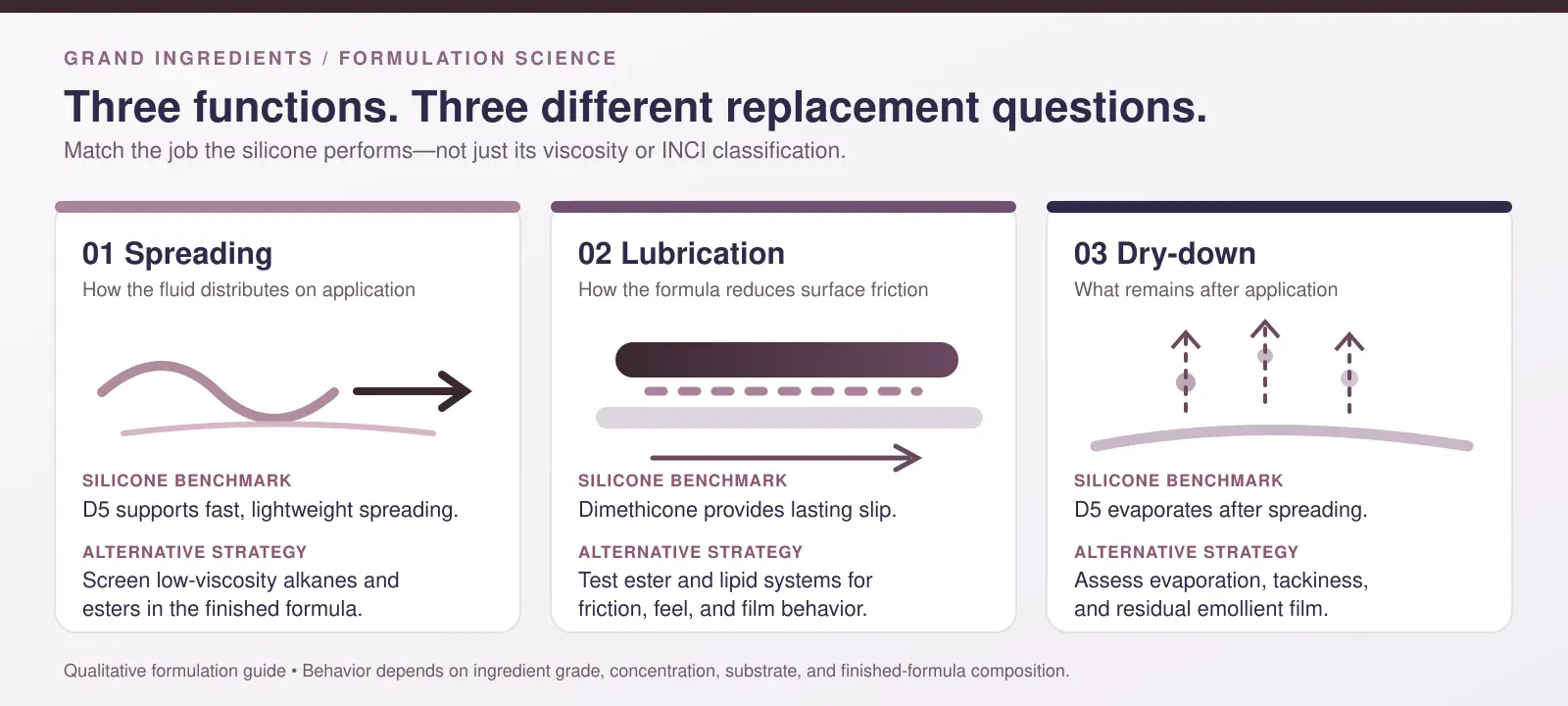
These three characteristics create different formulation challenges. D5 provides lightweight spreading and volatility, while nonvolatile Dimethicone contributes a more persistent lubricating film. An alternative system may use selected alkanes, esters, and engineered lipids to reproduce the desired sensory sequence, but the final balance depends on ingredient grade, concentration, substrate, processing and compatibility. Therefore, formulators should measure relevant properties in the complete product before claiming equivalence.
Natural Silicone Alternative Technologies
Natural silicone alternatives include several chemical families with different molecular structures and formulation functions. Plant-derived alkanes, specialty esters, engineered lipid systems and functional conditioners can each contribute to a replacement strategy, but they are not interchangeable. Rather than choosing solely by natural origin or marketing category, formulators should consider the material’s behavior in the intended product and the functions it must reproduce.
Plant-Derived Alkanes and Lightweight Emollients
Selected plant-derived alkane systems can support low-viscosity, lightweight formulations with favorable spreading characteristics. These materials are relevant when developing alternatives to certain volatile-carrier functions, although volatility differs across alkane structures. Consequently, chemists should assess spreading, evaporation or dry-down behavior, tackiness, compatibility and residual feel before treating an alkane as a suitable D5 replacement. A blend may provide a better balance than one component alone.
Specialty Esters and Engineered Sensory Performance
Specialty esters give formulators a versatile molecular toolkit. Carbon-chain length, branching, molecular weight and polarity influence viscosity, spreading, lubrication and compatibility, allowing researchers to explore different sensory profiles. Published studies on bio-based ester structures report promising results in selected cosmetic formulations, including favorable spreading and textural characteristics against specific silicone benchmarks. However, those results do not imply universal equivalence, particularly where silicone volatility is central to product performance.
By combining esters with complementary components, a formulation can separate the roles of initial spreading and residual lubrication. For example, one component may contribute a lighter application while another supports a soft, substantive after-feel. Nevertheless, the blend must remain compatible with the emulsifier system, fragrance, active ingredients, pigments and packaging. Its value lies in the performance of the complete formulation rather than the reputation of an individual ingredient.
Engineered Lipid and Conditioning Systems
Engineered lipid systems combine selected ingredients to influence lubrication, film formation, conditioning and sensory behavior. In skin care, they may help establish a targeted balance of softness and residual feel; in hair care, specialized conditioning chemistry adds another dimension through interactions with the fiber surface. Cationic systems, for instance, can support deposition and manageability, but their actual effect depends on molecular structure and formulation conditions. Consequently, hair-conditioning alternatives require wet and dry combability, friction, static and deposition evaluation rather than simple oil-substitution tests.
How to Select the Right Natural Silicone Alternative
The replacement pathway must start with the original silicone’s job. A lightweight serum containing D5 presents a different challenge from a hair conditioner containing Amodimethicone or a rich treatment based on high-viscosity Dimethicone. Therefore, chemists should define the desired sensory and physical parameters first, then select candidates and build controlled prototypes around those targets.
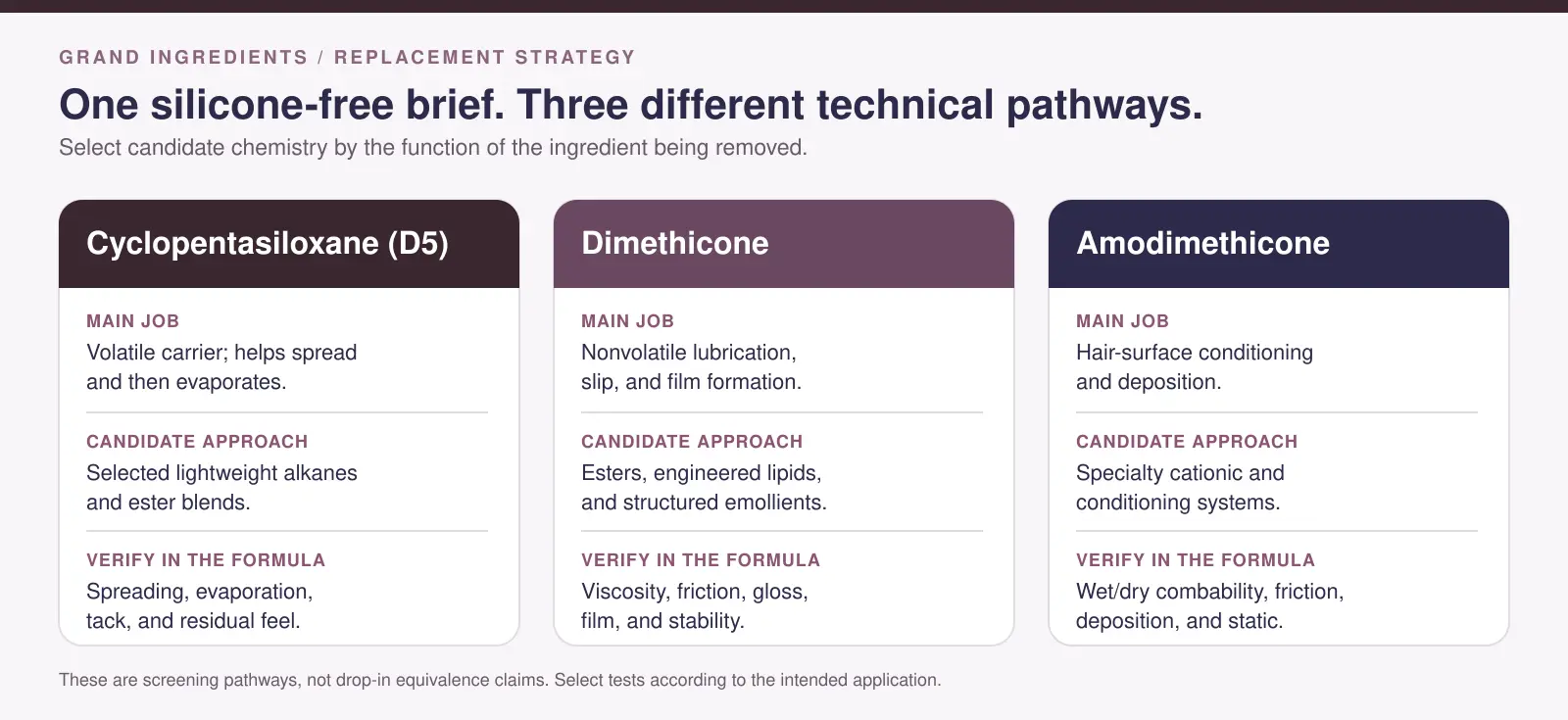
For D5, screening should emphasize lightweight spreading, dry-down and residual feel. In contrast, Dimethicone replacement requires careful attention to lubrication, film behavior, gloss, viscosity and physical stability. Amodimethicone replacement adds hair-surface considerations, including deposition, wet and dry combability, friction and antistatic performance. These distinctions help formulate efficient screening plans and prevent a promising material from being rejected simply because it was tested against the wrong function.
| Replacement target | Formulation objective | Grand Ingredients example |
|---|---|---|
| Cyclopentasiloxane (D5) | Lightweight sensory performance | Silike Volatile |
| Cyclomethicone-like feel | Velvety slip and sensory characteristics | Silike 91 PL |
| Lower-viscosity Dimethicone | Spreading, lubrication and gloss | Silike 350 |
| Medium-viscosity Dimethicone | Conditioning and smooth feel | Silike 1000 |
| Higher-viscosity Dimethicone | Film formation and lasting lubrication | Silike 10,000 |
| Amodimethicone-based systems | Hair conditioning and manageability | Silike 949 Natural |
These products represent candidate technologies rather than universal one-to-one replacements. Their suitability depends on the specific grade, concentration, formulation composition, processing and application. Formulators should examine the relevant technical documentation and evaluate prototypes under controlled conditions. The complete Grand Ingredients Natural Silicone Alternatives portfolio offers additional starting points for ingredient screening.
Application-Specific Reformulation
Skin Care: Elegant Spreading and Residual Feel
In moisturizers, serums and primers, silicones contribute to the sensory sequence from initial application through dry-down. Replacing a volatile silicone with a nonvolatile emollient can increase richness or leave a more persistent oily sensation, while selecting a candidate only for rapid spreading may reduce the softness expected from the reference. Therefore, a useful assessment examines initial drag and spreading, intermediate tackiness and gloss, and residual softness or oiliness after the product settles. Physical stability and compatibility must remain part of the evaluation throughout development.
Hair Care: Deposition, Combability and Conditioning
Hair conditioning depends on more than bulk-fluid viscosity. Conventional silicone systems can contribute lubrication, surface smoothness, softness and easier detangling, while the behavior of deposited material affects performance after rinsing and drying. A simple plant oil may improve lubrication without reproducing the surface interactions of a purpose-designed conditioner. Consequently, wet and dry combability, friction, antistatic behavior, gloss and mechanical performance provide a more meaningful evaluation framework than viscosity alone.
For example, Grand Ingredients’ Silike 949 Natural is a plant-derived conditioning technology developed as an alternative to conventional Amodimethicone-based systems. In supplier-reported instrumental testing, it demonstrated 48% less combing work compared with a shampoo-treated control and 22% higher tensile strength compared with a keratin-based conditioner. These results come from separate comparisons under specified test conditions, so they should not be generalized across all formulas or hair types. Nevertheless, they illustrate how relevant performance measurements can support the evaluation of specialized alternatives. Further information is available on the Silike 949 Natural product page.
Color Cosmetics: Pigment Compatibility and Film Performance
Color cosmetics introduce additional challenges because silicones can influence pigment wetting, dispersion, spreading, gloss, film formation and wear behavior. In foundations, primers and lip products, changing the emollient system can alter rheology and pigment stability even when the replacement material feels attractive in isolation. Therefore, evaluation should include pigment compatibility, transfer characteristics, film uniformity and stability where relevant. The best candidate for a facial serum may not be suitable for a long-wear foundation, because the performance targets differ.
Why Direct Silicone Substitution Sometimes Fails
A frequent mistake is to assume that two materials with comparable viscosities will provide comparable performance. However, spreading, residual emollience, lubrication, deposition and phase compatibility can change independently of viscosity. As a result, a prototype may appear acceptable during initial mixing but feel different on application or lose stability during storage. Rather than treating the result as a complete failure of the alternative chemistry, formulators should identify which function changed and investigate it systematically.
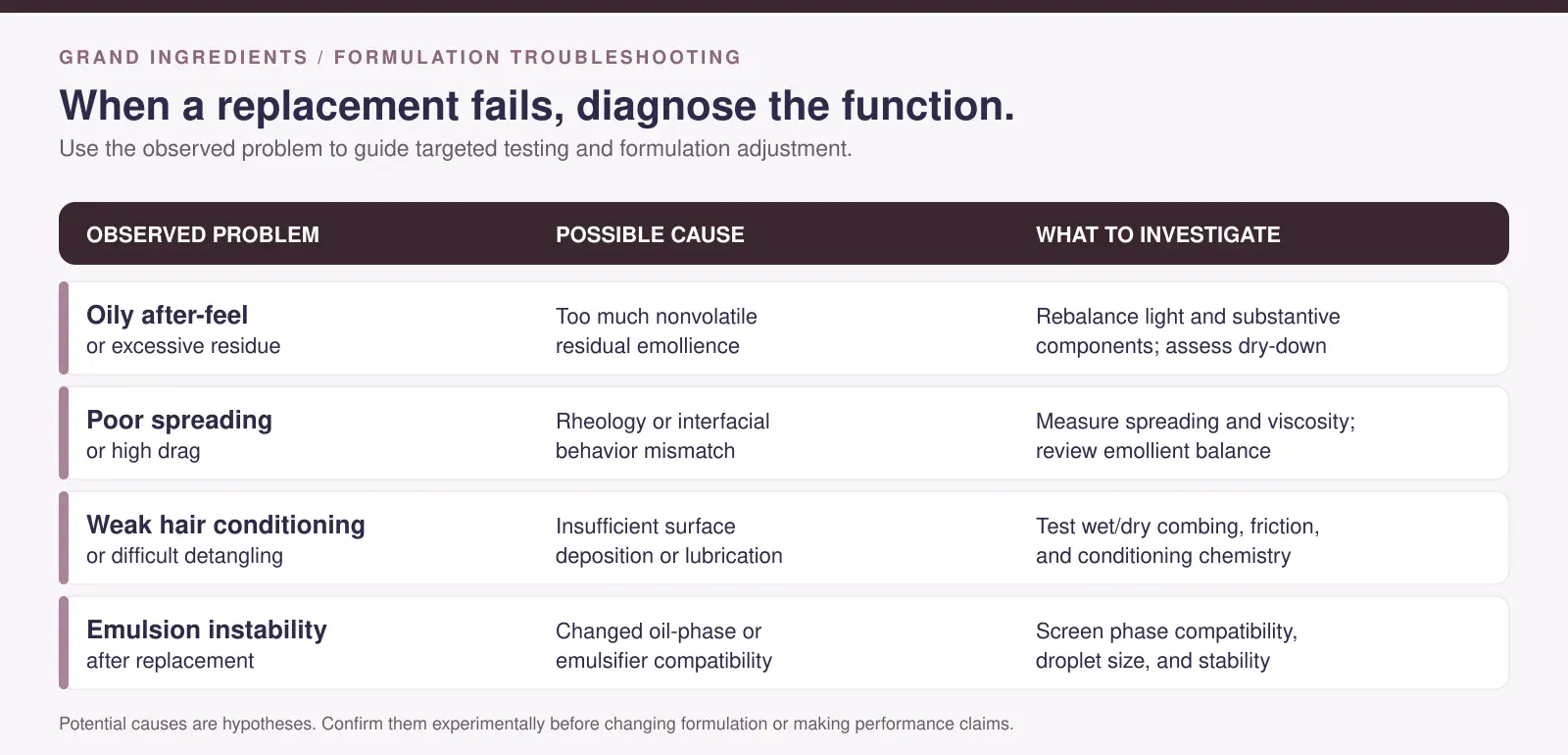
Excess oily residue may reflect a higher proportion of nonvolatile emollients, while poor spreading may arise from rheological or interfacial differences. In a conditioner, inadequate surface deposition or lubrication can reduce combability even when the substitute has a similar viscosity to the original silicone. Likewise, changing oil-phase composition may disturb the emulsifier balance and affect physical stability. These possible causes are hypotheses, not diagnoses; controlled testing should establish the mechanism before the formulation team adjusts the product.
A Practical Laboratory Strategy for Silicone Replacement
Structured evaluation helps research teams reduce trial-and-error development. The first objective is to establish a controlled reference formula and record the sensory, physicochemical and stability characteristics that matter most for the intended product. Next, the team should identify whether the original silicone contributes volatility, lubrication, conditioning, film formation, texture modification or several functions simultaneously. This assessment determines which candidates and tests are relevant.
- Establish the benchmark. Record formulation appearance, viscosity, stability, sensory profile and application-relevant properties of a controlled silicone-containing reference.
- Identify critical functions. Separate volatility, spreading, lubrication, conditioning, film formation and texture goals, then prioritize the functions that determine product success.
- Screen candidates. Compare technical specifications, compatibility and relevant physicochemical properties. Evaluate blends where one ingredient cannot reproduce the target behavior.
- Prepare controlled prototypes. Keep processing and comparison conditions consistent, then optimize candidate concentrations and formulation balance.
- Measure relevant performance. Use appropriate methods such as rheometry, spreading analysis, friction testing, combability, sensory panels, gloss or film evaluation.
- Validate the finished formula. Confirm physical stability, compatibility, repeatability, regulatory suitability and any relevant packaging or microbiological requirements.
The appropriate measurements depend on the product rather than on a universal checklist. A hair conditioner may prioritize combability and deposition, whereas a foundation may emphasize pigment stability, spreading and transfer behavior. Ultimately, the best replacement is the system that achieves the intended finished-product performance under defined conditions.
EU Silicone Restrictions and Formulation Planning
Regulatory changes have increased interest in alternatives to certain cyclic siloxanes. Commission Regulation (EU) 2024/1328 expanded REACH restrictions concerning D4, D5 and D6. Existing restrictions for D4 and D5 in wash-off cosmetics applied from January 31, 2020, while expanded restrictions cover other cosmetic products, including leave-on cosmetics, from June 6, 2027. The rules include a 0.1% weight threshold for covered substances, subject to detailed provisions and exceptions.
Importantly, these restrictions do not represent a general ban on every silicone ingredient. Linear Dimethicone differs chemically from cyclic D4, D5 and D6, so formulators must evaluate each material according to its own regulatory status. Early alternative screening can support long-term product planning, but regulatory compliance and technical performance remain separate considerations. The complete legal requirements appear in Commission Regulation (EU) 2024/1328.
Natural Origin, Biodegradability and Sustainability
Natural origin, renewable-carbon content, biodegradability and overall environmental impact describe different material characteristics. A plant-derived ingredient is not automatically biodegradable, and biodegradability alone does not establish that a material is environmentally preferable in every respect. Therefore, ingredient assessment should consider traceability, appropriate natural-origin documentation, relevant biodegradability studies, manufacturing characteristics, regulatory data and performance at the required use concentration.
Formulation efficiency also matters. A material that requires a substantially higher dose to reproduce one function may introduce different technical and sustainability trade-offs, even if it comes from renewable feedstocks. Consequently, the most credible selection process evaluates measurable performance alongside verified environmental attributes rather than relying on broad claims.
The Future of Silicone-Free Formulation Is Performance-Driven
Natural silicone alternatives are expanding the possibilities for cosmetic innovation, particularly as specialty esters, engineered lipid systems and conditioning technologies become more sophisticated. However, the most promising direction is not a universal silicone substitute; it is a set of technologies that formulators can select and combine according to specific performance requirements. A lightweight serum, a rich conditioning mask and a transfer-resistant foundation each demand different balances of spreading, lubrication, film behavior, compatibility and sensory feel.
By connecting ingredient science with application-specific testing, development teams can create silicone-free products that meet contemporary formulation objectives without abandoning the performance consumers expect. The goal is not simply to remove silicone—it is to understand what makes silicone effective and engineer a suitable alternative around those same functional requirements.
Explore Natural Silicone Alternative Technologies
Discover natural-origin silicone alternatives for skin care, hair care, and color cosmetics. Explore our advanced emollients and conditioning technologies, or connect with our team for samples, technical documentation, and formulation support.
Frequently Asked Questions
What are natural silicone alternatives?
Natural silicone alternatives are ingredient technologies designed to reproduce selected functions of conventional silicones using natural-origin or plant-derived materials. Depending on their chemistry, they may provide emollience, spreading, lubrication, film formation, conditioning or texture modification. Their suitability depends on the finished formulation and required performance.
Can natural silicone alternatives fully replace Dimethicone?
Selected materials can reproduce important functions such as slip, softness, gloss and film characteristics. Nevertheless, complete equivalence depends on the ingredient grade, concentration, compatibility and application. Formulators should validate candidate technologies against relevant benchmarks rather than assume a universal replacement.
What is a natural alternative to Cyclopentasiloxane?
Selected lightweight alkane systems, specialty esters and engineered blends can provide alternatives to certain D5 functions. However, they may not reproduce its evaporation behavior, so spreading, dry-down, tackiness and residual feel must guide the assessment. Combining complementary components can help target a more appropriate sensory balance.
Are natural silicone alternatives suitable for hair care?
Yes. Specialty conditioning technologies can support detangling, lubrication, softness and manageability without conventional silicone conditioning systems. However, the results depend on formulation chemistry and hair-surface interactions, so wet and dry combability, friction and deposition measurements provide valuable evidence.
Are natural silicone alternatives always biodegradable?
No. Natural origin and biodegradability are distinct characteristics that require separate evidence. Manufacturers should support such claims with relevant data for the specific material, while formulators should also consider functional performance and other environmental factors.
Scientific References
- Commission Regulation (EU) 2024/1328, REACH restrictions on D4, D5 and D6.
- Bio-based alternatives to volatile silicones: Chemical structure, physicochemical properties and performance.
- Exploring bio-based alternatives to cyclopentasiloxane.
- Physicochemical Properties of New Silicone Alternatives.
- On Hair Care Physicochemistry and Biobased Conditioning Agents.