
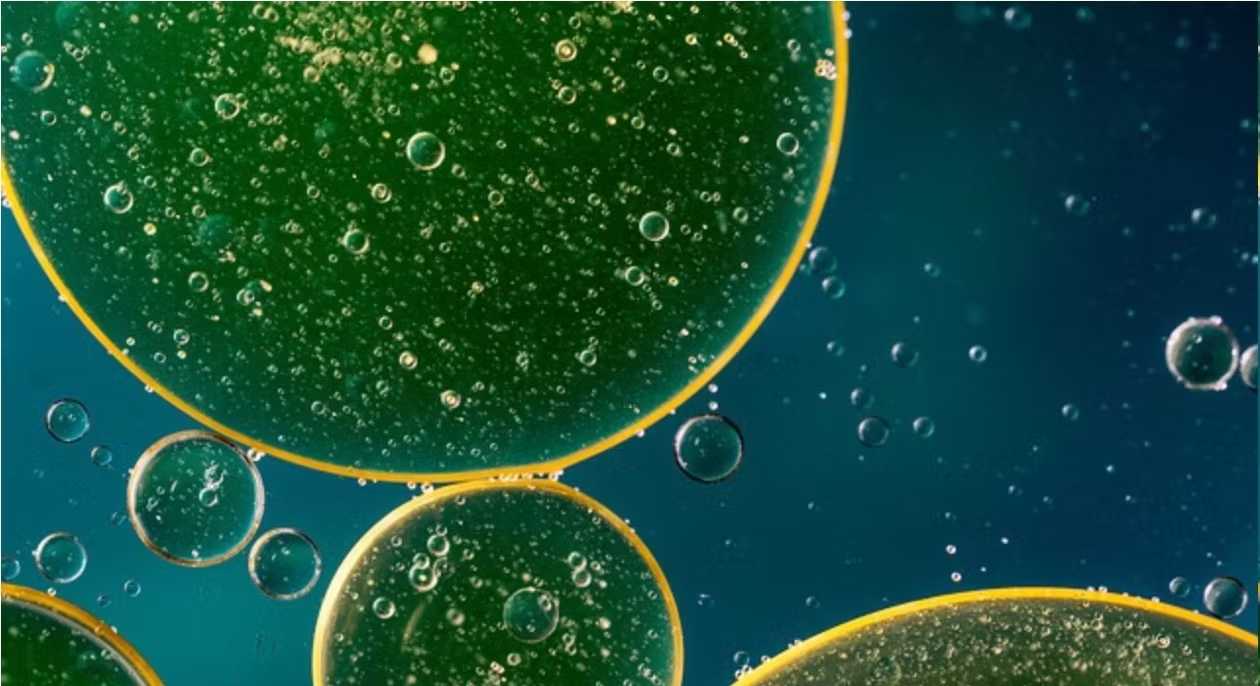
Microemulsions and nanoemulsions are frequently grouped together because both involve oil–water systems with very small structural dimensions. However, despite superficial similarities in appearance and droplet size, these two systems are governed by fundamentally different physical principles. Confusing microemulsions with nanoemulsions leads to incorrect stability expectations, formulation failure during scale-up, and inefficient ingredient selection.
This article provides a comprehensive, system-level comparison of microemulsion and nanoemulsion systems. It explains how each system forms, why their stability mechanisms differ, how formulation constraints shape their use, and how to decide which system is appropriate for a given application across food, cosmetic, pharmaceutical, and industrial formulations.
Why the Distinction Matters
The distinction between microemulsions and nanoemulsions is not academic. It directly affects formulation cost, surfactant load, processing complexity, regulatory positioning, and long-term stability.
Microemulsions are thermodynamically stable systems that form spontaneously under the right compositional conditions. Nanoemulsions, in contrast, are kinetically stable dispersions that require external energy to form and will eventually destabilize over time.
Understanding this difference allows formulators to design systems intentionally rather than retroactively troubleshooting instability.
What Is a Microemulsion?
A microemulsion is a thermodynamically stable, isotropic system composed of oil, water, surfactant, and often a co-surfactant. These systems form spontaneously when interfacial tension is reduced to near-zero values.
Because microemulsions minimize free energy, they do not require mechanical energy to form and remain stable indefinitely as long as temperature and composition remain within the microemulsion region.
Structural Nature of Microemulsions
Unlike conventional emulsions, microemulsions do not consist of discrete droplets separated by well-defined interfaces. Instead, they contain dynamic nanoscopic domains that continuously reorganize.
Depending on composition, microemulsions may exist as:
- Oil-in-water microemulsions
- Water-in-oil microemulsions
- Bicontinuous microemulsions
This dynamic structure explains their optical clarity and low viscosity despite extremely small domain sizes.
What Is a Nanoemulsion?
A nanoemulsion is a kinetically stable dispersion of oil droplets in water (or vice versa) with droplet sizes typically ranging from 20 to 200 nanometers. Unlike microemulsions, nanoemulsions are not thermodynamically stable.
They require external energy input to reduce droplet size and rely on emulsifiers to slow destabilization processes.
Droplet-Based Architecture
Nanoemulsions consist of discrete droplets surrounded by interfacial films. These droplets behave like miniature particles suspended in a continuous phase.
Stability depends on droplet size distribution, interfacial elasticity, emulsifier coverage, and resistance to coalescence and Ostwald ripening.
Thermodynamic vs Kinetic Stability
The defining difference between microemulsions and nanoemulsions lies in stability.
Microemulsions are thermodynamically stable because they occupy a minimum free-energy state. As a result, they do not separate over time.
Nanoemulsions are kinetically stable because droplet movement and coalescence are slowed, not eliminated. Over sufficient time, they will eventually destabilize.
This distinction explains why microemulsions tolerate long storage without change, while nanoemulsions require careful shelf-life evaluation.
Interfacial Tension and Its Role
Microemulsions require extremely low interfacial tension—often approaching zero. This condition allows spontaneous interface formation without energy input.
Nanoemulsions operate at higher interfacial tension. Mechanical energy is used to overcome this barrier and create small droplets.
As a result, microemulsions demand higher surfactant loads, while nanoemulsions trade energy input for reduced surfactant concentration.
Surfactant and Co-Surfactant Requirements
Microemulsions
Microemulsions typically require high surfactant concentrations and often include co-surfactants such as short-chain alcohols or polyols. These components work together to reduce interfacial tension and expand the microemulsion region.
This requirement limits microemulsion use in applications sensitive to surfactant load.
Nanoemulsions
Nanoemulsions use lower surfactant levels but rely on emulsifier efficiency and processing conditions. Emulsifier selection focuses on interfacial elasticity and long-term resistance to destabilization.
Formation Methods
Microemulsion Formation
Microemulsions form spontaneously once the correct composition is achieved. Phase diagrams guide formulation by mapping regions where microemulsions exist.
No high shear or specialized equipment is required.
Nanoemulsion Formation
Nanoemulsions require energy input. Common methods include:
- High-pressure homogenization
- Ultrasonication
- Phase inversion emulsification
Processing conditions strongly influence droplet size and stability.
Template Comparison: Microemulsion vs Nanoemulsion
| Parameter | Microemulsion | Nanoemulsion |
|---|---|---|
| Stability type | Thermodynamic | Kinetic |
| Energy input | None | Required |
| Surfactant load | High | Low–Moderate |
| Structure | Dynamic domains | Discrete droplets |
| Long-term stability | Indefinite | Finite |
Failure Modes
Microemulsion Breakdown
Microemulsions fail when formulation variables move outside the microemulsion region. Temperature shifts, electrolyte changes, or oil polarity variation can trigger phase separation.
Nanoemulsion Destabilization
Nanoemulsions destabilize through:
- Coalescence
- Ostwald ripening
- Interfacial film fatigue
Application-Driven System Selection
Microemulsions are suited for applications requiring solubilization, transparency, and thermodynamic stability where high surfactant load is acceptable.
Nanoemulsions are suited for delivery-focused systems where lower surfactant levels, controlled release, and tunable droplet size are priorities.
Scale-Up Considerations
Microemulsions scale easily once composition is fixed. Nanoemulsions require careful control of shear, pressure, and temperature during scale-up.
Failure to account for these differences often leads to pilot-scale success but production-scale failure.
System-Level Design Philosophy
Choosing between microemulsion and nanoemulsion systems requires aligning formulation goals with physical reality. Thermodynamic stability trades off against surfactant load, while kinetic stability trades off against processing complexity.
Understanding this trade-off prevents unrealistic expectations and inefficient formulation cycles.
Key Takeaways
- Microemulsions are thermodynamically stable systems
- Nanoemulsions are kinetically stable dispersions
- Surfactant and energy requirements differ fundamentally
- Correct system selection is critical for success


