A Multifunctional Skin Performance System
Today’s consumers expect skincare to do more than address a single concern. Therefore, SCH Blend® Well-Age was developed as a multifunctional cosmetic active system designed to support visibly younger, brighter, and more resilient skin.
By combining clarifying, brightening, anti-inflammatory, antioxidant, and penetration-enhancing actions, this advanced system targets multiple biological pathways at once. As a result, it supports smoother texture, improved tone uniformity, enhanced hydration, and a reduction in the appearance of wrinkles.
Rather than relying on a single mechanism, SCH Blend® Well-Age functions as a system-level solution. Consequently, it delivers balanced performance across pigmentation, elasticity, luminosity, and skin comfort.
Main Activities
At the core of SCH Blend® Well-Age is a multifunctional activity profile. Specifically, the system supports:
- Clarifying and whitening effects
- Anti-inflammatory activity
- Reduction in the appearance of wrinkles
- Enhanced penetration of active ingredients
- Brightening and tone uniformity
- Antioxidant protection against oxidative stress
Together, these activities allow formulators to address several visible signs of skin aging within a single formulation framework.
Key Ingredients and Mechanisms
Potassium Azeloyl Diglycinate (PAD)
Clarifying · Moisturizing · Anti-Inflammatory
Potassium azeloyl diglycinate represents a stabilized derivative of azelaic acid combined with glycine. Compared to free azelaic acid, this structure improves tolerability while maintaining efficacy.
Mechanistically, PAD inhibits tyrosinase activity within the melanogenic pathway. More specifically, it interferes with the conversion of L-Dopachrome from Dopaquinone. Therefore, it supports visible brightening and tone correction.
At the same time, glycine—an essential component of the natural moisturizing factor—helps soften the skin and maintain hydration. As a result, PAD contributes to both moisture retention and surface smoothness.
Moreover, PAD enhances the permeation and availability of azelaic acid within the dermal-epidermal matrix. In parallel, it demonstrates anti-inflammatory activity through IL-1 inhibition and seboregulatory effects. Consequently, it supports clarifying results without unwanted shine.
Tetrahydropiperine (THP)
Penetration Enhancer
Tetrahydropiperine is a derivative of piperine, a natural alkaloid extracted from black pepper. Within SCH Blend® Well-Age, THP plays a critical enabling role.
Specifically, THP increases bioavailability and diffusion of active ingredients by enhancing intercellular transport through the stratum corneum. In doing so, it reduces the electrochemical resistance of intercorneocytic lipid bilayers.
Furthermore, THP improves the cosmeto-kinetics of active ingredients by delaying enzymatic degradation triggered by cutaneous xenobiotic receptors. As a result, actives remain available for longer periods within the skin.
Glabridin
Clarifying · Anti-Inflammatory · Antioxidant
Glabridin is an isoflavonoid extracted from licorice root and is widely recognized for its multifunctional skin benefits. Structurally, its annular hydroxylic configuration (C6, C7, C8) allows non-competitive inhibition of TRP-1 and TRP-2 tyrosinase activity.
Accordingly, glabridin irreversibly reduces tyrosinase activity. In addition, it regulates melanotropin (α-MSH) signaling, which plays a central role in melanogenesis. Therefore, it supports visible pigmentation control and brightening.
Beyond pigmentation, glabridin suppresses superoxide anion formation. Moreover, it inhibits the NF-κB pathway and cyclooxygenase-2 expression. Consequently, it helps protect the skin against UVB-induced oxidative stress and inflammation.
Nonapeptide-1 (NP-1)
Clarifying
Nonapeptide-1 is a biomimetic peptide designed to interact with melanocortin-1 receptors (MC1-R), which regulate melanin synthesis. By targeting these receptors, NP-1 reduces the expression of tyrosinase-related agents involved in eumelanin production.
Because eumelanin contributes to darker pigmentation, this mechanism helps reduce hyperpigmentation, age spots, and uneven tone. As a result, skin appears brighter and more uniform over time.
Dermatological Studies
Depigmenting Efficacy Under Dermatological Control
To validate performance, a cosmetic product containing SCH Blend® Well-Age was evaluated in 22 volunteers with pigmented skin over a 56-day period. During this time, biometric and instrumental measurements were used to assess multiple skin parameters related to pigmentation, skin quality, and appearance.
Immediate Results (Measured just 4 Hours after a single application):
- +31% Increase in Skin Elasticity (Statistically significant)
- +15% Improvement in Firmness
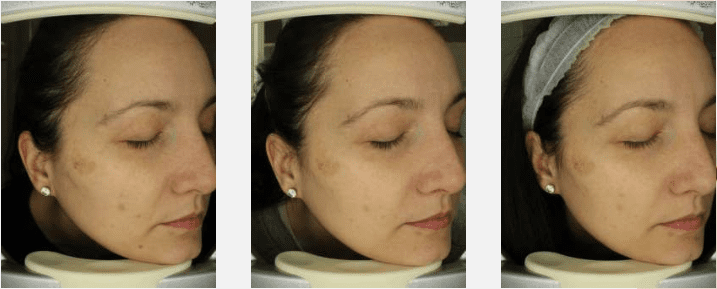
Representative dermatological images showing visible evolution of pigmented areas at baseline (T0), after 28 days (T28), and after 56 days (T56) of use.
Key Efficacy Outcomes
- Elasticity: Up to 31% statistically significant increase after short-term application
- Firmness: Up to 15% improvement after 4 hours
- Hydration: 6% increase after 56 days
- Luminosity: 14% improvement after 56 days
- Tone Uniformity: 17% improvement after 56 days
- Wrinkles (Forehead): 40% statistically significant reduction after 56 days
- Additionally, spot coloration decreased by 7% with continued use.
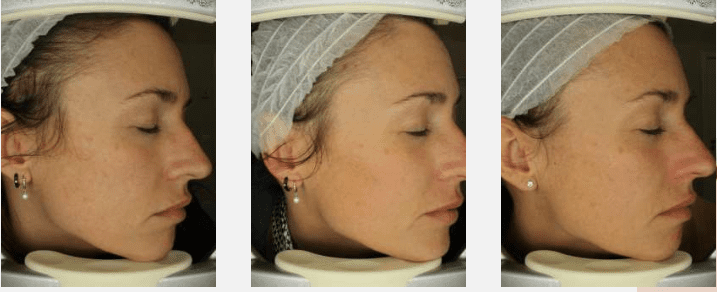
Visual assessment illustrating progressive reduction in pigmentation intensity and improved tone uniformity from baseline (T0) to 56 days (T56).
Tolerance Evaluation
Overall, dermatological assessment confirmed good tolerance. Mild dryness was reported in three volunteers, while one case of comedogenicity was observed.
Formulation Guidance
From a formulation perspective, SCH Blend® Well-Age offers high flexibility. Specifically, it is supplied as a water-soluble system designed for easy integration.
- Recommended use level: 2–5%
- Suitable for: creams, emulsions, serums, and targeted treatments
Positioning Summary
Ultimately, SCH Blend® Well-Age delivers a balanced, system-driven approach to brightening and anti-aging skincare. By combining multi-pathway activity with dermatological evaluation, it allows formulators to simplify product design while still delivering visible, measurable results.
For further details on SCH Blend Well-Age, you can visit the product page here