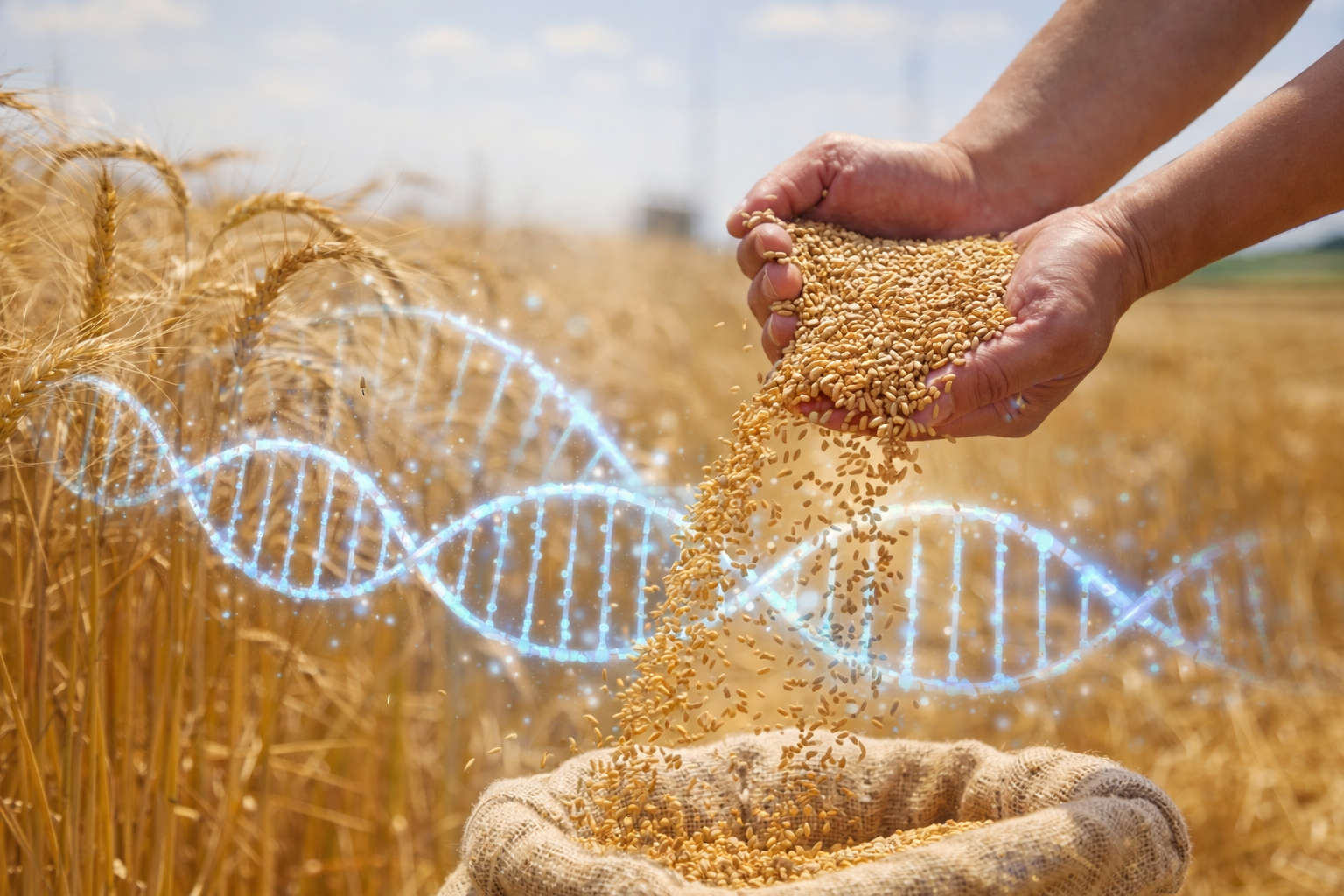
Rice PDRN has become one of the fastest-moving actives in modern K-beauty–inspired skincare. However, marketing language has moved faster than the underlying chemistry. As a result, many discussions treat Rice PDRN as a clearly defined ingredient, even though its composition, performance, and behavior depend heavily on source and formulation.
Therefore, this article translates current PDRN science into a practical, chemist-first roadmap. It explains what Rice PDRN most likely represents, what published literature actually supports, where evidence remains limited, and how formulators and brand owners can build claims that withstand both consumer expectations and regulatory scrutiny.
What Rice PDRN Means in Skincare
Rice PDRN represents a source narrative, not a fixed identity
PDRN stands for polydeoxyribonucleotide, which refers to a mixture of DNA fragments composed of oligo- and polynucleotides. Importantly, the molecular weight distribution of these fragments varies according to raw material source and manufacturing process. In cosmetic formulations, suppliers typically list PDRN-class materials as Sodium DNA or closely related INCI variations, depending on regional conventions.
In practice, the term “Rice PDRN” usually describes a plant-origin positioning that supports vegan or non-animal sourcing claims. However, this description does not define molecular structure, purity, or performance. Consequently, two materials marketed as Rice PDRN may differ substantially in composition and functionality.
The material fingerprint determines performance
To achieve consistent performance, formulators must treat Rice PDRN as a complex biomaterial rather than as a single-molecule active. In most cases, the performance-critical fingerprint includes:
- molecular weight distribution rather than a single average value
- DNA fragment length profile, including the balance between oligonucleotides and polynucleotides
- purity, particularly the ratio of nucleic acids to residual carbohydrates or proteins
- ionic strength and counter-ion composition, which influence conformation and compatibility
- bioburden control and endotoxin strategy, especially for post-stress positioning
- stability across pH range, temperature cycling, and freeze–thaw conditions
Without this data, it becomes difficult to compare suppliers or predict formulation behavior.
How Rice PDRN Works: The Most Defensible Mechanisms
Adenosine A2A receptor signaling
Current literature most strongly supports PDRN’s association with adenosine receptor biology, particularly A2A receptor signaling in repair-adjacent contexts. A foundational fibroblast study demonstrated increased human skin fibroblast proliferation following PDRN exposure, while A2 antagonists reduced this effect. Together, these findings support a mechanistic link to A2-mediated pathways.
However, this evidence does not suggest that topical PDRN behaves like an injectable or produces medical outcomes. Instead, it provides a plausible biological rationale for cosmetic effects when formulators design delivery, format, and use context appropriately.
Nucleotide salvage support
Researchers also describe PDRN as a pool of nucleotides and DNA fragments that can support cellular recovery processes under stress conditions. This concept helps explain why PDRN frequently appears in wound-healing and recovery literature.
Nevertheless, formulators should treat this rationale as supportive rather than deterministic. In topical skincare, delivery limitations across intact stratum corneum still apply and shape real-world performance.
Mechanistic endpoints suitable for cosmetic claims
When developing educational content or label copy, brands should anchor scientific discussion around endpoints that align with both literature and cosmetic compliance. For example, defensible endpoints include:
- improvement in the appearance of skin following visible stress
- support of barrier function, including reduced transepidermal water loss and improved hydration
- enhancement of skin texture and smoothness metrics
- reduction in the visible signs of irritation, supported by instrumental redness data and comfort scoring
The Evidence Ladder: Separating Science from Hype
This evidence ladder clarifies which claims rest on strong mechanistic support and which require direct product-level validation.
Level A: Mechanistic plausibility
Published literature connects PDRN to A2A receptor signaling and downstream phosphorylation cascades associated with proliferation, migration, and repair-adjacent biology. In addition, plant-derived PDRN research demonstrates similar pathway activation alongside improvements in barrier- or wound-model systems. More recently, microbial-derived PDRN studies have reinforced the feasibility of non-animal PDRN systems.
At this level, brands should focus on education and mechanism rather than outcome promises.
Level B: Translational evidence with contextual limits
Many well-documented PDRN outcomes originate from medical, injectable, or procedural contexts. These settings involve compromised barriers, direct delivery, or post-procedure skin conditions that differ significantly from intact-skin cosmetic use.
Therefore, when cosmetic marketing implies equivalence to these contexts, credibility suffers. In contrast, brands that acknowledge delivery limitations and validate outcomes through cosmetic-grade testing build trust and authority.
Level C: Rice-specific public evidence remains limited
Public, peer-reviewed literature provides relatively limited data on rice-derived PDRN in topical cosmetic applications. Instead, suppliers often rely on proprietary testing and internal data packages.
While such data can support internal decision-making, brands ultimately gain competitive advantage by generating product-level substantiation and maintaining transparent specification control.
Rice PDRN Delivery in Topical Skincare
Why intact-skin delivery presents challenges
Polynucleotides are large, hydrophilic molecules that do not naturally favor passive diffusion across intact stratum corneum. For this reason, inconsistent consumer feedback often reflects formulation format or delivery strategy rather than intrinsic ingredient inefficacy.
Accordingly, formulation design should focus on maximizing meaningful surface contact, supporting barrier function, and enabling measurable cosmetic outcomes.
Positioning strategies that increase credibility
Topical Rice PDRN products tend to perform best when brands apply one or more of the following strategies:
- post-stress or post-procedure appearance support, where barrier disruption is relevant and substantiated
- encapsulation or delivery systems such as liposomes, niosomes, or polymeric carriers with validated stability
- high-contact formats, including ampoules, hydrogel masks, occlusive gels, and overnight treatments
- barrier-first formulation architecture combining PDRN with humectants and skin-identical lipids
Formulation Blueprint for Rice PDRN Products
Step 1: Qualify the ingredient as a biomaterial
Formulators should request and archive a complete technical dossier that includes:
- full specification with assay methodology and acceptance criteria
- molecular weight distribution data
- impurity profile covering proteins, carbohydrates, and residual solvents or reagents
- microbial limits, bioburden controls, and preservation recommendations
- defined pH stability window and electrolyte sensitivity
- accelerated, real-time, and freeze–thaw stability data
Step 2: Define a protective pH and compatibility strategy
In practice, and in the absence of supplier-specific data, a mid-range pH provides the safest environment for many polynucleotide systems. Highly acidic or alkaline conditions increase risk unless stability data proves otherwise. At the same time, ionic strength requires careful monitoring, as salts, buffers, and cationic polymers can destabilize delivery systems or alter rheology.
Therefore, compatibility screening should include common formulation stressors such as niacinamide, chelators, carbomers, and widely used solubilizers.
Step 3: Preserve for real-world use
Water-based biomaterials can increase microbial risk if preservation design falls short. For this reason, formulators should conduct preservative efficacy testing early and repeat it after packaging selection. When positioning products for post-stress or post-procedure use, teams should justify and document tighter microbial specifications.
Step 4: Build a measurable support matrix
Because PDRN’s reputation aligns strongly with recovery contexts, topical products should deliver visible, measurable benefits even if DNA fragment penetration remains limited. High-performing Rice PDRN formulas typically combine:
- a structured humectant system such as glycerin, betaine, and multi-weight hyaluronic acid
- barrier lipids following ceramide, cholesterol, and free fatty acid logic or simplified analogs
- soothing agents selected according to positioning, including panthenol, allantoin, ectoin, or bisabolol
- optional encapsulation systems validated within the formulation’s pH and ionic environment
Claims and Substantiation Strategy
Barrier and hydration support
The fastest and most defensible substantiation pathway often includes:
- transepidermal water loss measurements
- corneometry for hydration
- clinical grading for dryness and roughness
Soothing and post-stress appearance
For PDRN-adjacent positioning, brands can also support claims through:
- instrumental redness measurement using chromameter or standardized imaging
- subjective comfort scoring for sensations such as tightness or stinging
- controlled stress protocols, when ethically appropriate
In vitro and ex vivo support
When aligned with claim language, supplementary models may include:
- keratinocyte or fibroblast markers relevant to barrier and comfort
- three-dimensional skin models assessing barrier recovery and visible inflammation markers
Claim-safe language examples
When supported by the above testing, defensible claims may include:
- helps support the skin barrier
- improves hydration for smoother-looking skin
- helps reduce the appearance of redness associated with dryness or visible stress
- supports skin comfort and post-stress appearance
Brands should avoid language that implies equivalence to injectables or medical procedures and instead emphasize measured cosmetic outcomes.
Research sources (links)
- Thellung S. et al. “Polydeoxyribonucleotides enhance the proliferation of human skin fibroblasts: involvement of A2 purinergic receptor subtypes.” (1999).
https://www.sciencedirect.com/science/article/abs/pii/S0024320599001046 - PubMed record for the same 1999 fibroblast/A2 receptor study (useful for citation consistency).
https://pubmed.ncbi.nlm.nih.gov/10328526/ - Lee KS. et al. “Analysis of Skin Regeneration and Barrier-Improvement Effects of Panax PDRN…” (2023, PMC).
https://pmc.ncbi.nlm.nih.gov/articles/PMC10649580/ - Squadrito F. et al. “Pharmacological Activity and Clinical Use of PDRN.” (Frontiers in Pharmacology, 2017).
https://www.frontiersin.org/journals/pharmacology/articles/10.3389/fphar.2017.00224/full - Chae D. et al. “First Report on Microbial-Derived Polydeoxyribonucleotide…” (2025, PubMed).
https://pubmed.ncbi.nlm.nih.gov/39852156/ - Park S. et al. “Clinical Applications, Pharmacological Effects, Molecular…” (Applied Sciences, 2025).
https://www.mdpi.com/2076-3417/15/19/10437 - Additional contextual overview mentioning PDRN/Sodium DNA usage in consumer skincare.
https://incidecoder.com/ingredients/sodium-dna