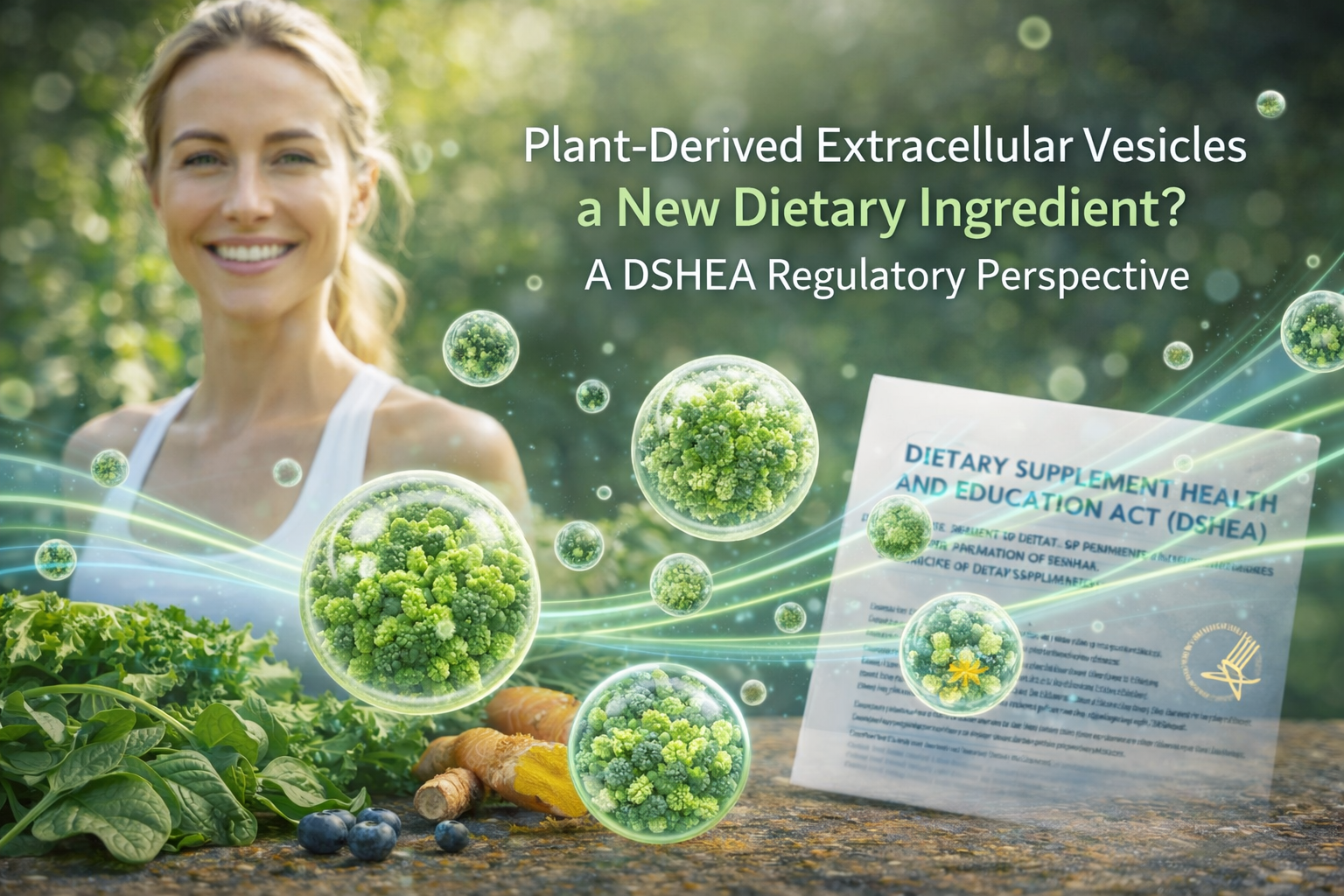
Innovation without regulatory clarity is liability. Consequently, any emerging ingredient platform must be evaluated not only for scientific merit, but also for its legal positioning under United States dietary supplement law. In the case of plant-derived extracellular vesicles (EVs), sometimes referred to as plant-derived exosomes, the primary question is not whether they are technologically interesting. Instead, the core issue is regulatory classification.
Specifically, do vesicle-rich botanical concentrates qualify as a New Dietary Ingredient (NDI) under the Dietary Supplement Health and Education Act of 1994 (DSHEA)? The answer does not depend on marketing language. Rather, it depends on statutory definitions, manufacturing boundaries, and historical exposure.
Understanding the NDI Framework
Under DSHEA, a dietary ingredient marketed in the United States prior to October 15, 1994 does not require submission of a New Dietary Ingredient Notification. However, ingredients introduced after that date may require notification unless they were present in the food supply in a form that has not been chemically altered.
Therefore, two regulatory filters apply. First, the source material must have a documented history in the food supply. Second, the processing must not constitute chemical alteration. If either condition fails, NDI notification becomes necessary.
Importantly, FDA does not pre-approve dietary ingredients. Instead, the burden of safety and compliance rests with the manufacturer or distributor. Consequently, companies must independently evaluate whether their ingredient meets statutory thresholds.
Food-Origin as the Primary Anchor
Plant-derived vesicle concentrates originate exclusively from edible fruits and vegetables. These source materials possess a long-standing history of safe consumption. Consequently, the botanical origin itself does not introduce novelty.
However, novelty can arise from processing. Regulatory evaluation dated December 18, 2025 assessed vesicle-rich fractions derived from edible plant materials and concluded that, when used within historical dietary exposure ranges, such materials do not meet the definition of a New Dietary Ingredient.
This determination hinges on the fact that the ingredient represents a concentrated fraction of conventional food rather than a newly synthesized compound.
Processing Boundaries and Non-Chemical Alteration
The second regulatory axis concerns chemical alteration. FDA draft guidance clarifies that physical processing steps such as concentration, filtration, dehydration, or mechanical separation do not necessarily constitute chemical modification if molecular identity remains unchanged.
In the regulatory review referenced above, manufacturing involved mechanical extraction, centrifugation, filtration, and freeze-drying. No organic solvents, synthetic reagents, or structural modifications were introduced. As a result, the vesicle-rich fraction was characterized as a physically concentrated food component rather than a chemically altered derivative.
This distinction is critical. A chemically modified ingredient may trigger NDI requirements, whereas a non-chemically altered food fraction may not.
What Regulatory Alignment Does Not Imply
Regulatory alignment under DSHEA does not equal FDA approval. Dietary supplements are not subject to pre-market approval. Moreover, alignment with NDI exemptions does not authorize disease claims or therapeutic positioning.
Structure-function claims must remain truthful, substantiated, and properly disclaimed. Therefore, commercialization strategies must emphasize documentation, restraint, and claim discipline.
Risk Mitigation and Documentation Strategy
Companies exploring vesicle-rich botanical ingredients should implement a structured compliance process. This begins with supplier verification and traceability documentation. Next, manufacturing steps must be mapped against FDA’s non-chemical alteration guidance. Additionally, intended use levels should be evaluated relative to historical dietary exposure.
Legal review of marketing language is equally important. Overstated claims increase enforcement risk and invite scrutiny from regulators and competitors alike.
When documentation is robust and language remains conservative, regulatory risk decreases substantially. Furthermore, procurement confidence improves, particularly among retailers with strict compliance standards.
Strategic Implications for the Supplement Market
Compared to synthetic nano-delivery technologies, food-derived vesicle concentrates may offer a lower regulatory barrier when properly positioned. However, this advantage depends entirely on disciplined manufacturing and responsible communication.
Brands that prioritize compliance at the beginning of product development reduce the likelihood of reformulation, relabeling, or enforcement actions later. Consequently, regulatory strategy should precede marketing campaigns.
In emerging ingredient categories, credibility compounds over time. Early operators who document thoroughly and communicate conservatively often define the market narrative.
Conclusion
Plant-derived extracellular vesicle concentrates occupy a unique regulatory position. Because they originate from conventional edible botanicals and may be manufactured without chemical alteration, they can align with DSHEA dietary ingredient frameworks when used within historical exposure parameters.
However, regulatory alignment is not automatic. It requires documented sourcing, controlled manufacturing, appropriate use levels, and disciplined claim strategy. When those conditions are met, vesicle-rich botanical fractions represent a structurally innovative yet compliance-conscious pathway in functional nutrition.
Ultimately, innovation in the supplement industry succeeds when scientific advancement and regulatory precision move together. Companies that recognize this balance will lead the category responsibly.