


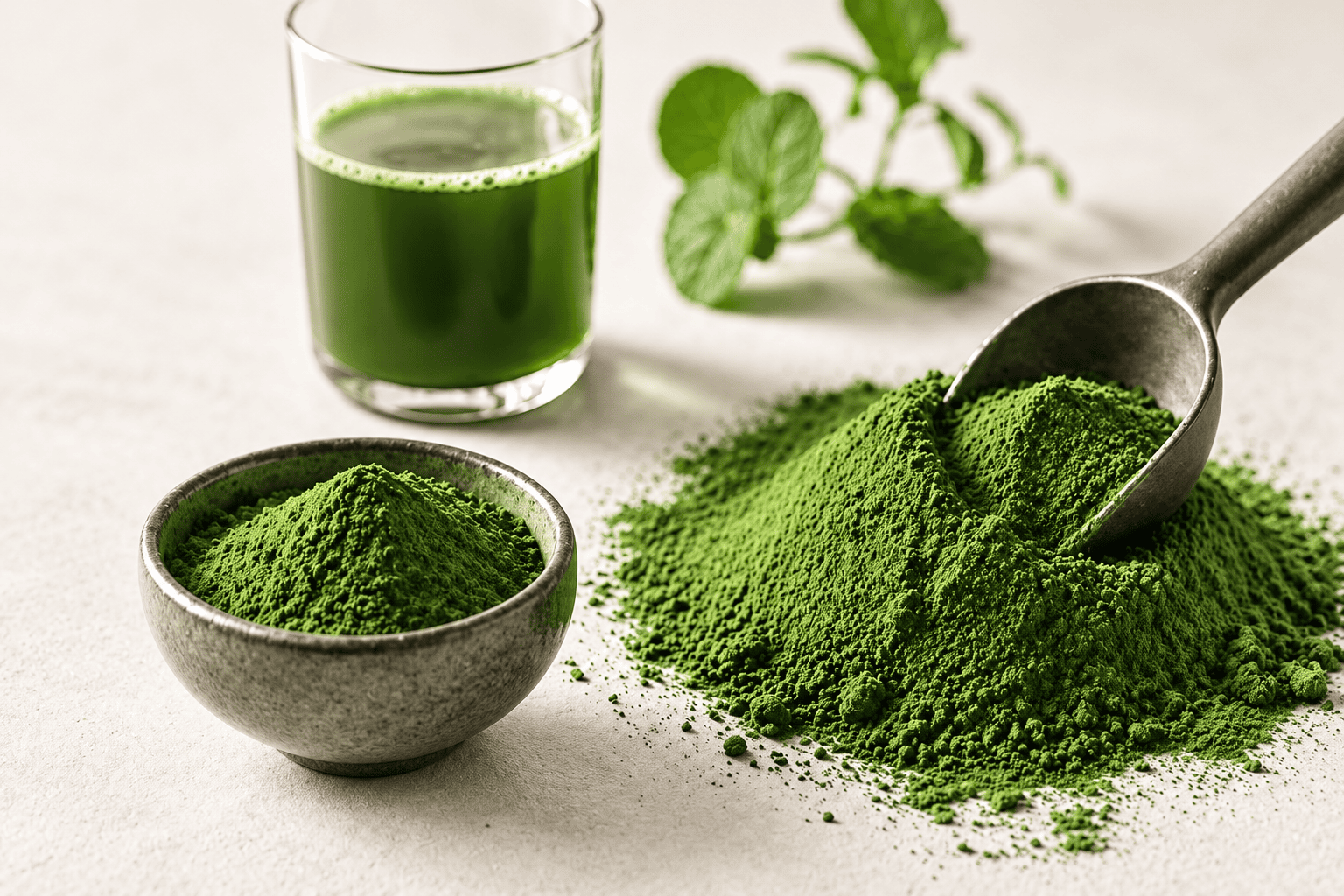
Nannochloropsis sp. is a nutrient-rich marine microalga that combines long-chain omega-3 fatty acids, proteins, amino acids, pigments, and naturally occurring micronutrients within a single biological matrix. Particularly valued for its eicosapentaenoic acid (EPA) content, this microalgal ingredient offers a broader nutritional profile than isolated omega-3 oils. Its composition makes it relevant to nutraceuticals, functional foods, cosmetics, and animal nutrition, where formulators increasingly seek multifunctional ingredients supported by biotechnology and nutritional science.
The ingredient provides approximately 2–5% EPA according to the stated product specification, alongside proteins, amino acids, vitamins, minerals, chlorophyll, and xanthophyll antioxidants. Its lipid fraction also contains phospholipids and glycolipids, which contribute to the structural organization of the organism’s cellular membranes. Together, these components create opportunities for formulations that combine omega-3 nutrition with the additional nutritional characteristics of microalgal biomass.
Marine Biotechnology and Nutrient Production
How Nannochloropsis Produces EPA
Nannochloropsis belongs to a group of photosynthetic microorganisms capable of synthesizing long-chain polyunsaturated fatty acids. These organisms use light energy and carbon dioxide to support cellular growth while producing lipids essential to membrane structure and normal metabolic activity. EPA forms an important component of the lipid fraction and represents one of the primary reasons for the organism’s commercial interest.
Unlike fish-derived omega-3, which accumulates through marine food webs, Nannochloropsis produces EPA directly through its own metabolic pathways. Controlled cultivation allows producers to manage environmental variables such as light intensity, temperature, nutrient availability, and growth duration. These conditions influence biomass productivity, lipid composition, and the relative concentration of EPA.
Cultivation and Biochemical Consistency
Microalgal cultivation provides opportunities to standardize production and control the quality of harvested biomass. However, the balance between total lipid accumulation and EPA production is particularly important. Conditions that stimulate storage lipid production do not necessarily increase the proportion of EPA, which is frequently associated with membrane lipids.
For commercial ingredient production, maintaining a consistent balance of nutrients requires carefully managed cultivation and harvesting processes. The resulting biomass may then undergo drying, milling, or additional processing to produce a powder suitable for incorporation into finished formulations.
EPA Content and Nutritional Composition
EPA: A Long-Chain Omega-3 Fatty Acid
Eicosapentaenoic acid (EPA) is a 20-carbon omega-3 fatty acid containing five double bonds. This molecular structure supports its incorporation into cellular membranes and its participation in lipid-mediated signaling pathways. These properties have made EPA an important focus of research involving cardiovascular function, lipid metabolism, and inflammatory regulation.
With a stated EPA content of approximately 2–5%, Nannochloropsis offers a source of long-chain omega-3 within a broader nutritional ingredient. Unlike purified EPA concentrates, the biomass contains additional macronutrients and bioactive components that may contribute to its overall nutritional value.
The distinction between total EPA concentration and EPA bioavailability remains important. The ability to release EPA from the microalgal cells during digestion depends on the processing method and integrity of the cell wall.
Proteins and Amino Acid Composition
Beyond omega-3 fatty acids, Nannochloropsis contains proteins that contribute to the nutritional composition of the biomass. Published investigations have documented substantial protein concentrations in selected species, although the amount and amino acid distribution depend on cultivation conditions and processing.
Protein content creates opportunities for incorporating the ingredient into nutritional blends, functional foods, and selected animal feed applications. Amino acid characterization and digestibility testing help determine the ingredient’s practical nutritional contribution.
Because microalgal cell walls can limit access to intracellular proteins, processing methods that improve cell disruption may also influence protein digestibility and overall nutrient availability.
Vitamins, Minerals, and Micronutrients
Nannochloropsis biomass contains a range of minerals and other micronutrients. Reported compositions include calcium, magnesium, potassium, iron, and additional trace elements, with concentrations influenced by species and cultivation conditions.
These nutrients broaden the ingredient’s potential beyond EPA delivery alone. Nevertheless, the presence of a nutrient does not automatically establish that the ingredient supplies a nutritionally significant amount at its intended use level.
For finished-product development, micronutrient claims should reflect batch-specific analytical data, serving size, and the regulatory requirements applicable to each market.
Chlorophyll and Xanthophyll Antioxidants
Chlorophyll and Natural Pigment Function
The characteristic green appearance of Nannochloropsis originates partly from chlorophyll, the primary pigment involved in photosynthetic light absorption. Its presence contributes to the visual identity of the biomass and creates opportunities for naturally colored formulations.
Chlorophyll-containing extracts have also attracted interest in antioxidant research. However, the antioxidant activity of a purified pigment cannot automatically be used to establish the biological performance of whole Nannochloropsis powder.
Pigment concentration, extraction conditions, degradation, and formulation stability determine the contribution of these compounds to a specific preparation.
Xanthophylls and Oxidative Stress
Nannochloropsis can contain carotenoid pigments, including xanthophylls such as violaxanthin and vaucheriaxanthin, depending on the species and cultivation conditions. These compounds contribute to photosynthetic light management and protective responses within the microalgal cells.
Their conjugated molecular structures provide a biochemical basis for investigating antioxidant properties. Research into microalgal carotenoids suggests potential relevance to oxidative stress management, although biological effects depend on the identity and concentration of individual compounds.
For product developers, the combination of carotenoids, chlorophyll, and EPA supports a differentiated microalgal ingredient concept, provided functional claims are supported by appropriate analysis and testing.

Phospholipids, Glycolipids, and the Microalgal Lipid Matrix
Membrane-Associated EPA
One distinguishing feature of Nannochloropsis is the distribution of EPA across different lipid classes. In addition to storage lipids, the organism contains membrane-associated phospholipids and glycolipids that contribute to cellular architecture.
These molecules play important structural roles in biological membranes. Their fatty acid composition influences membrane organization and the function of the photosynthetic organism under different environmental conditions.
The presence of EPA in different lipid classes is also relevant to nutritional ingredient characterization. However, improved human bioavailability cannot be assumed from the presence of phospholipids or glycolipids alone.
Why the Complete Lipid Matrix Matters
Whole microalgal biomass presents a different formulation profile from concentrated or refined omega-3 oils. Instead of supplying predominantly isolated lipids, it delivers EPA within a complex matrix containing proteins, pigments, carbohydrates, and membrane structures.
This composition may support broader nutritional positioning, but it also introduces processing challenges. Cell wall integrity, particle size, digestive accessibility, and lipid oxidation all influence the ingredient’s practical performance.
Understanding these factors allows formulators to evaluate the advantages and limitations of whole-biomass ingredients more accurately.
Biological Mechanisms and Nutritional Function
EPA and Inflammatory Signaling
EPA participates in physiological signaling through enzymatic conversion into selected eicosanoids and specialized pro-resolving mediators. These molecules are involved in coordinating inflammatory responses and their resolution.
This mechanism contributes to scientific interest in EPA-rich nutritional ingredients. However, the amount of EPA delivered by a serving of microalgal powder may differ substantially from doses investigated in clinical studies of concentrated omega-3 preparations.
Product-specific intake levels must therefore be considered when evaluating nutritional relevance and potential claims.
Lipid Metabolism and Cardiovascular Research
EPA has been extensively investigated for its influence on triglyceride metabolism and the production of triglyceride-rich lipoproteins. These effects involve several metabolic pathways, including hepatic fatty acid metabolism and lipoprotein regulation.
Clinical triglyceride-lowering evidence primarily involves defined doses of concentrated EPA or EPA/DHA preparations. The findings provide relevant biological context for Nannochloropsis, but they do not establish equivalent clinical effects from whole biomass containing 2–5% EPA.
For formulators, accurate EPA content and intended serving size remain essential when translating this research into product development.
Nannochloropsis Compared with Other Microalgal Ingredients
Different microalgal ingredients provide distinct combinations of lipids, proteins, pigments, and other components. Understanding these differences helps formulators select materials according to the primary objective of a finished product.
| Characteristic | Nannochloropsis | Schizochytrium Oil | Spirulina Biomass |
|---|---|---|---|
| Primary nutritional emphasis | EPA and mixed nutrients | DHA, sometimes EPA | Protein and other nutrients |
| Ingredient matrix | Whole microalgal biomass | Concentrated oil | Whole cyanobacterial biomass |
| Additional components | Protein, minerals, pigments | Other fatty acids, formulation-dependent additives | Protein, pigments, minerals |
| Typical physical form | Powder | Oil or encapsulated powder | Powder |
| Relevant applications | Nutrition, functional foods, feed, cosmetics | Omega-3 supplements, fortified foods | Nutritional blends, foods |
| Main formulation challenge | Cell wall accessibility, sensory properties | Oxidative stability | Taste, color, sensory compatibility |
The comparison highlights the distinct position of Nannochloropsis as an EPA-containing multifunctional biomass rather than a purified omega-3 oil. Its nutritional value comes from its combination of components, while the specific contribution of each depends on the commercial ingredient’s composition.
Nutraceutical and Functional Food Applications
Multifunctional Nutritional Formulations
Nannochloropsis powder offers opportunities for nutritional products seeking an ingredient that combines EPA with proteins, pigments, and micronutrients. This is particularly relevant where formulators prefer whole-biomass ingredients rather than isolated fatty acid concentrates.
Potential applications include nutritional powders, capsules, and selected functional food concepts. The ingredient’s dosage, EPA contribution, nutrient concentration, and digestibility must be considered to determine whether it meets the nutritional objectives of the finished product.
Processing and Nutrient Accessibility
The relatively resistant cell wall of Nannochloropsis presents an important challenge for nutritional formulation. Research has demonstrated that intact cells can limit digestive access to intracellular proteins, lipids, and carotenoids.
Mechanical disruption techniques, including high-pressure homogenization and milling, can improve nutrient accessibility. In one published in vitro investigation, high-pressure homogenization produced approximately a threefold improvement in omega-3 bioaccessibility compared with untreated biomass.
These findings demonstrate why processing technology is important for nutritional performance. They do not establish the digestibility of a specific commercial powder unless its processing characteristics and relevant testing data are available.
Sensory and Product Development Considerations
Whole Nannochloropsis biomass has a characteristic green color and may contribute marine, grassy, or other algal sensory notes depending on processing and concentration. These properties can influence its suitability for finished foods.
Powdered nutritional blends and capsules may provide practical incorporation options. Formulators developing beverages or other sensitive food matrices must evaluate dispersibility, sedimentation, color development, flavor compatibility, and stability.
Because food-use permissions vary by ingredient identity and jurisdiction, regulatory authorization must also be confirmed before commercial use.
Cosmetic Formulations and Skin-Related Research
Microalgal Antioxidant Concepts
The presence of carotenoids, chlorophyll, and other microalgal components creates opportunities to investigate Nannochloropsis in cosmetic concepts addressing oxidative stress and environmental exposure.
Its value in topical skincare, however, depends on the commercial preparation. Whole powder, aqueous extracts, and lipid extracts differ in physical properties, active concentrations, and formulation compatibility.
Antioxidant performance in laboratory assays should be distinguished from demonstrated benefits in skin cells or human clinical studies.
Applications in Personal Care
Potential cosmetic research applications include microalgae-based masks, rinse-off products, and suitable emulsions or suspended systems. Pigments may contribute natural coloration, while characterized extracts could offer additional formulation opportunities.
For whole powder, particle size, dispersion, microbiological quality, sensory characteristics, and preservation compatibility require particular attention. Formulators should also evaluate whether the material’s physical properties are appropriate for leave-on or rinse-off use.
Claims relating to skin hydration, barrier repair, redness, or anti-aging effects require dedicated efficacy studies on the specific ingredient or finished formulation.
Animal Nutrition and Aquaculture Applications
A Source of Marine Lipids and Nutrients
Nannochloropsis has received considerable attention in aquaculture nutrition because it combines EPA with proteins and other components relevant to aquatic feed development.
Its marine origin makes it particularly interesting in feed systems designed to provide long-chain omega-3 fatty acids through alternative ingredient sources. Controlled cultivation can also support supply consistency and traceability.
Digestibility and Inclusion Strategy
The nutritional performance of microalgal biomass depends partly on how efficiently the target animal can digest and absorb its intracellular components. Feed research has demonstrated that cell wall disruption can improve the digestibility of Nannochloropsis proteins and lipids.
Optimal inclusion levels differ between animal species and finished diet compositions. Commercial development should therefore rely on species-specific nutritional trials and ingredient specifications rather than assuming that higher inclusion levels always improve performance.
Formulation Stability and Quality Control
Protecting EPA Against Oxidation
EPA contains multiple double bonds that make it susceptible to oxidative degradation. Exposure to oxygen, heat, and light can affect the fatty acid composition of microalgal ingredients during processing and storage.
Suitable packaging, controlled drying conditions, and storage management can help protect product quality. Depending on the commercial formulation, antioxidant stabilization may also be appropriate.
Maintaining Nutritional and Pigment Quality
Beyond EPA stability, whole-biomass ingredients require attention to moisture content, microbiological quality, pigment degradation, and particle characteristics.
Analytical specifications help establish batch consistency and support formulation development. Parameters such as EPA concentration, total protein, moisture, microbial counts, and relevant contaminants provide important information for commercial qualification.
Controlled Cultivation and Sustainable Ingredient Development
Marine Microalgae as a Production Platform
Nannochloropsis can be cultivated in controlled systems designed to manage the conditions influencing biomass growth and nutrient composition. These approaches offer opportunities for consistent production without depending on harvested fish as the omega-3 source.
Environmental performance depends on the energy, water, nutrients, and processing technologies used. Consequently, the sustainability profile of an individual commercial ingredient should be supported by relevant production information.
Expanding the Value of Microalgal Biomass
The combined presence of EPA, protein, pigments, and additional cellular components creates opportunities for integrated microalgal processing. Instead of focusing exclusively on extracting omega-3 oil, production strategies can investigate the value of multiple biomass fractions.
This approach supports continued research into ingredient standardization, improved extraction techniques, nutrient accessibility, and the efficient use of cultivated biomass.
Advancing Multifunctional Nutrition Through Microalgal Science
Nannochloropsis sp. represents a distinctive ingredient within the expanding field of microalgal biotechnology. Its value extends beyond the presence of EPA to include a broader composition of proteins, amino acids, pigments, minerals, and structural lipids.
This nutritional diversity creates opportunities for manufacturers developing multifunctional nutraceuticals, functional foods, cosmetic concepts, and animal nutrition products. However, achieving reproducible performance requires attention to ingredient composition, processing, nutrient accessibility, and formulation stability.
For product developers, Nannochloropsis offers an approach to combining marine omega-3 nutrition with the broader functionality of cultivated microalgal biomass. Careful ingredient characterization and application-specific testing provide the foundation for translating these characteristics into scientifically supported finished products.
Scientific References
- Uthaiah, N. M., et al. (2025). Oleaginous microalgae Nannochloropsis sp. as a potential source of EPA and bioactive metabolites: Bottlenecks in downstream processing and challenges in food, feed and therapeutic applications. Algal Research. https://doi.org/10.1016/j.algal.2025.103897
- Large-scale production of Nannochloropsis-derived EPA: Current status and perspectives via a biorefinery context. (2024). Food and Bioproducts Processing. https://doi.org/10.1016/j.fbp.2024.09.002
- Bioactivity and Digestibility of Microalgae Tetraselmis sp. and Nannochloropsis sp. as Basis of Their Potential as Novel Functional Foods. (2023). Nutrients, 15(2), 477. https://pmc.ncbi.nlm.nih.gov/articles/PMC9861193/
- Cell disruption of Nannochloropsis sp. improves in vitro bioaccessibility of carotenoids and omega-3 long-chain polyunsaturated fatty acids. https://www.sciencedirect.com/science/article/pii/S1756464619306942
- In vitro bioaccessibility of proteins and lipids of pH-shift processed Nannochloropsis oculata microalga. (2016). Food & Function. https://pubmed.ncbi.nlm.nih.gov/27045666/
- Cell wall disruption increases bioavailability of Nannochloropsis gaditana nutrients for juvenile Nile tilapia. (2019). Aquaculture. https://doi.org/10.1016/j.aquaculture.2018.09.047
- Biomass nutrient profiles of the microalga Nannochloropsis. (2001). Journal of Agricultural and Food Chemistry. h


