

The evolution of high-performance skincare is increasingly defined, not just by the active ingredients, but by the sophistication of the delivery system used to introduce them to the skin. Consequently, in this pursuit of efficacy, a specialized class of ocean-derived compounds—Marine Phospholipids—has emerged as the gold standard for targeted delivery, stability, and fundamental barrier repair.
To begin with, this moves beyond the topical hydration realm. Marine phospholipids, often sourced from microalgae or krill, play two indispensable roles. On one hand, they are critical lipid restorers that seamlessly integrate into the skin’s barrier. On the other hand, they serve as the foundational structural blocks for creating advanced liposomes and nanocarriers.
This deep dive is aimed at cosmetic chemists, formulators, and brand leaders. It covers the mechanics, sourcing, and formulation advantages of marine phospholipid-based delivery systems. Ultimately, this deep knowledge helps brands achieve true dermocosmetic efficacy.
Part I: The Biochemical Foundation of Marine Lipids
To truly appreciate the power of marine delivery systems, therefore, we must first understand the fundamental role of the lipids themselves.
1. The Structure of Phospholipids
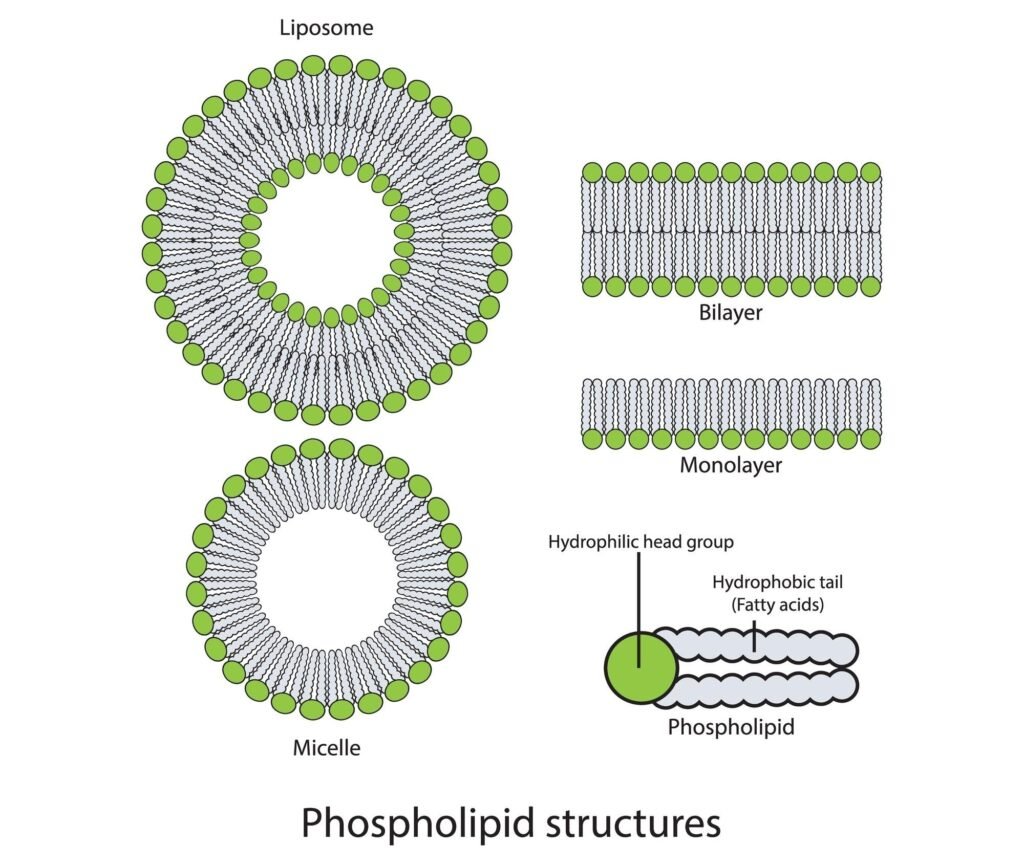
Phospholipids form the structural backbone of every cell membrane in nature. Specifically, they possess an amphiphilic character:
- The Hydrophilic Head: A phosphate group makes this end polar; consequently, it readily attracts water.
- The Hydrophobic Tails: Typically two fatty acid chains, these ends repel water and attract oil.
As a result, when placed in water, these molecules spontaneously self-assemble into a bilayer structure
2. Omega Fatty Acids: More Than Just Supplements
Marine phospholipids are uniquely rich in long-chain polyunsaturated fatty acids (PUFAs). These include Eicosapentaenoic Acid (EPA, C20:5) and Docosahexaenoic Acid (DHA, C22:6), the renowned Omega-3s. Significantly, their cosmetic benefits extend far beyond general skin health:
- Anti-Inflammatory Modulation: EPA and DHA actively compete with the Omega-6 precursor, arachidonic acid, in inflammatory pathways. By doing this, they suppress the production of pro-inflammatory eicosanoids. Consequently, this leads to a profound soothing effect, reduces redness, and mitigates damage from sub-clinical inflammation known as “inflammaging.”
- Stratum Corneum Fluidity: The long, highly unsaturated chains of these marine fatty acids maintain the proper fluidity and elasticity of the skin’s lipid matrix. In essence, this prevents the barrier from becoming rigid and brittle, a common issue in conditions like eczema and severe dryness.
- Epidermal Reinforcement: Unlike terrestrial phospholipids (like soy lecithin), marine phospholipids offer a profile that more closely mirrors the lamellar gel phase of the stratum corneum. Therefore, this allows for seamless, functional integration and barrier repair.
Part II: Liposomes: Solving the Delivery Challenge
The primary technical benefit of marine phospholipids is their ability to form liposomes. Liposomes are spherical, nano-sized vesicles composed of one or more concentric phospholipid bilayers. Crucially, liposomes overcome the two greatest obstacles in topical skincare: stability and penetration.
1. Protection and Encapsulation
Many gold-standard active ingredients, such as Retinol, Ascorbic Acid (Vitamin C), and specific peptides, are chemically fragile. For instance, they are highly susceptible to:
- Oxidation upon exposure to air and light.
- Hydrolysis (breakdown by water) in the formula’s aqueous phase.
- Reaction with other ingredients (e.g., pH incompatibility).
Liposomal encapsulation solves this problem by creating an internal micro-environment shielded by the bilayer.
- Water-Soluble Actives (e.g., Peptides, Marine Minerals): The aqueous interior core holds them. Meanwhile,
- Oil-Soluble Actives (e.g., Retinoids, Vitamin E): Formulators embed these within the hydrophobic core of the bilayer itself.
Ultimately, this protection ensures the active remains intact and potent. It dramatically extends the shelf life and enables the formulation of high-concentration, clinically effective products.
2. Targeted Penetration and Fusion
The most significant advantage of liposomes is their ability to navigate the skin’s defense systems for targeted delivery, often called “smuggling” the active.
- Biomimicry and Absorption: The skin naturally recognizes the phospholipid structure. Consequently, the liposome is readily absorbed or fuses with the keratinocyte’s plasma membrane and the inter-corneocyte lipid matrix. It is important to note that it does not get rejected or evaporate on the surface (like many free actives).
- Enhanced Targeting: Formulators can guide the carrier toward deeper layers of the epidermis or specific cellular targets. They achieve this by modifying the surface charge or adding specific targeting ligands to the liposome’s head. Furthermore, this maximizes efficacy and minimizes off-target activity or irritation.
- Increased Bioavailability: Liposomal delivery can boost the bioavailability (the degree and rate at which an active is absorbed) of ingredients by up to ten times compared to the free form. Therefore, this is a critical metric for justifying high-performance claims.
Part III: Formulation and Manufacturing Deep Dive
Implementing marine phospholipids and liposomal technology requires specialized knowledge of sourcing and precise formulation techniques.
1. Sourcing and Sustainability
Both performance and sustainability drive the shift toward marine-derived phospholipids.
- Algae and Microalgae: These are increasingly favored sources. Specifically, they offer a highly consistent yield of EPA and DHA phospholipids. Thus, this provides a vegan-friendly and highly scalable alternative to krill or fish oils. Cultivation is often conducted in closed-loop systems, minimizing environmental impact.
- Purity and Concentration: Sourcing from marine environments ensures a concentration of specific lipids. Moreover, this is often unobtainable from terrestrial sources (like soy or egg yolk lecithin). Consequently, this leads to stronger, more stable liposomal structures.
2. The Mechanics of Liposome Formation (Extrusion vs. Homogenization)
Chemists create liposomes using high-energy mechanical processes. They force the phospholipids to form stable, uniformly sized vesicles, often between 50 nm and 200 nm.
- Homogenization: This process uses high-shear mixing to physically break down large lipid structures into nanovesicles. However,
- Extrusion: This involves passing the lipid dispersion under high pressure through membranes of defined pore sizes. As a result, it yields highly uniform, monodisperse liposomes that offer the best quality control and efficacy.
In summary, the quality of the source phospholipid directly impacts the final lamellarity (single or multiple bilayers) and the loading capacity (how much active the liposome can hold).
3. Formulation Compatibility
While liposomes are robust, their stability must be maintained within the final cosmetic base:
- pH Tolerance: The optimal stability range for most cosmetic liposomes is typically between pH 5.0 and 7.0. Conveniently, this perfectly aligns with the skin’s natural, slightly acidic mantle.
- Avoidance of High Surfactant Loads: High concentrations of strong surfactants (detergents) can disrupt and solubilize the phospholipid bilayer. This means the active payload may be released prematurely. Instead, formulators must select gentle, stabilizing co-emulsifiers.
- Temperature Sensitivity: Complex lipids, proteins, or enzymes are often encapsulated. Therefore, the final formulation process requires cold-mixing or addition at low temperatures to prevent thermal degradation.
Part IV: The Market and Clinical Advantage
The use of marine phospholipid delivery systems is a strategic differentiator. In turn, it directly supports high-value claims in the marketplace.
1. Enhanced Claims and Consumer Trust
By using this technology, brands can make claims that resonate with the highly educated consumer:
- “Targeted Delivery System”: This is a verifiable claim that the active is reaching the intended site, not just sitting on the surface.
- “Clinical Stability Guaranteed”: This assures the consumer that sensitive actives like Retinol or Vitamin C maintain potency until used.
- “Reduced Irritation”: Encapsulation can dramatically lower the peak concentration of an active on the surface. Consequently, this makes highly potent ingredients gentler for sensitive skin users.
2. Synergy with Other Marine Actives
The liposome forms a powerful synergy with other marine ingredients previously discussed:
- Marine Enzyme Protection: Liposomes can encapsulate delicate Marine Enzymes. Thus, this protects them until they reach the target stratum corneum layer, ensuring controlled, non-irritating proteolysis.
- Mineral and Water Transport: Phospholipid-rich formulas support the osmotic balance regulated by Marine Minerals. In this way, this creates a biochemically optimized environment for hydration and cellular function.
3. The Future: Multi-Layer Liposomes and Transfersomes
Research pushes toward even more advanced systems:
- Multi-Lamellar Vesicles (MLVs): Liposomes with multiple concentric bilayers offer greater stability. Furthermore, they can carry multiple actives with different solubilities simultaneously.
- Transfersomes: These are highly flexible, ultradeformable liposomes. Essentially, they are designed to squeeze through the tight junctions of the stratum corneum, pushing the boundaries of non-invasive transdermal delivery.
Conclusion
Marine phospholipids are far more than just nourishing lipids. Rather, they are the architects of the next generation of high-efficacy skincare. By mastering their dual role—as fundamental barrier restorers and as the foundational material for liposomal delivery systems—cosmetic chemists can overcome persistent challenges of stability and penetration.
Adopting this technology commits a brand to precision. It enables formulators to deliver stable, highly bioavailable, and targeted actives deep into the skin where they perform their best work. Therefore, this strategic focus is essential for any brand seeking leadership in modern, science-backed dermocosmetics.
I understand. You just need the direct links from the research search.
Here are the three direct research links supporting the information in the article: